


Taurus, the mountains that trapped the sky.
In the eastern highlands of modern-day Turkey, a ragged boundary of limestone and basalt separates the Anatolian valleys from the flat plains of Mesopotamia. For millennia these peaks, soaring over three thousand meters, have trapped rainclouds drifting in from Asia to the east and the Indian Ocean to the south.
Unable to pass over the towering peaks, these rainclouds instead wander through the valleys and gorges carved in the mountains. Warm air from southern deserts mixes with these clouds, making them even more denser resulting in unusually heavy, thunderous rainfall especially during spring and summer.
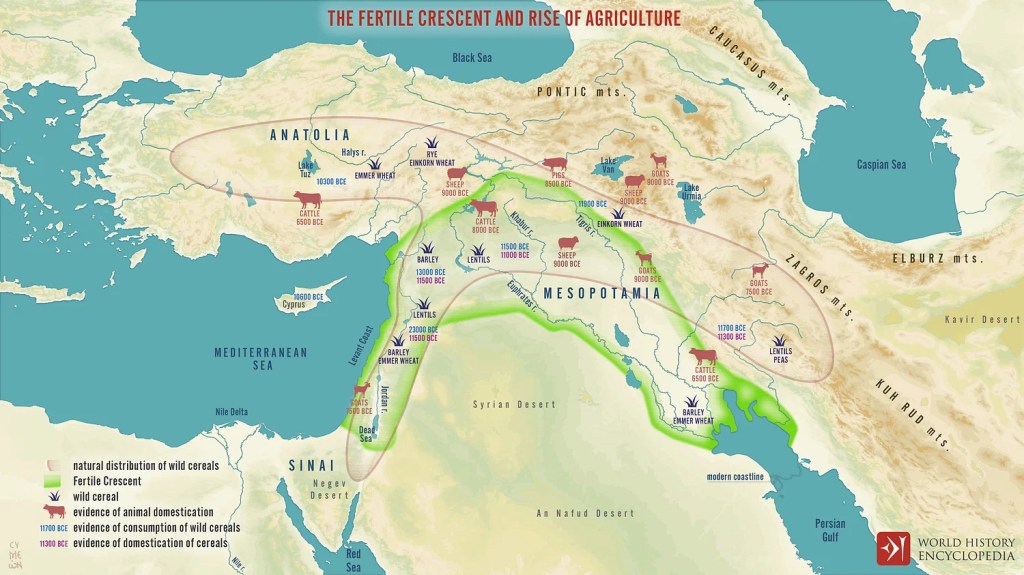
Before cities, before kings, even before farming, the Taurus Mountains shaped human destiny. This simple accident of geography, mountains trapping clouds, changed everything. For thousands of years, the Taurus Mountains trapped rainclouds create a lush green arc in an otherwise unforgiving landscape: the ‘Fertile Crescent.’
Here, in this crescent of green shaped by rock and water, humans took their first steps toward civilization. Tens and thousands of years before our direct ancestors made their home, these valleys were already alive with archaic humans. Archaeological traces of Homo erectus show that they roamed these ridges nearly half a million years ago. Our direct ancestors, Homo sapiens, followed, drawn by game, fresh water, and fertile ground.
Storm god, bulls and thunderous rainfall. (- 11000 BC)
This unusual rain formed underwater lakes and small streams within the mountains which joined to form small rivers. Over geological time, rivers flowing from these highlands carved canyons, wore down limestone ridges, and carried vast quantities of silt southward. Soil rich in silt are remarkably good at retaining water and allows air to circulate – making an ideal habitat for most crops.
Fed by streams from the snowcapped caucus mountains of eastern Europe, these waters formed two legendary rivers: the Tigris and the Euphrates. Their floodplains became the lifeblood of south, which otherwise is nothing but an inhospitable desert. These rivers sculpted the land, depositing rich silt across floodplains creating fertile farmlands in what would later become Mesopotamia.
Water shaped not only the land but also the beliefs of its earliest people. The name “Taurus” comes from the Latin word for bull- a nod to terracotta bull figurines un-earthed across the region. Early hunter-gatherers worshipped a storm god Teshub, who they believed rode an enormous bull and thundered across the skies in heaven. The roar of summer thunderstorms must have sounded like hooves galloping overhead – a divine reminder that rain was both gift and threat.
From hunter gathers to first farmers. (11000- 6500BC)
For much of prehistory, humans survived by hunting and gathering, moving as the seasons and herds demanded. Early neolithic hunter gatherers rather dwelled in the foothills of mountains in the north where the temperature was temperate, rain was plentiful and natural resources were abundant.
But around 11,000 BC, everything begun to change as the hunter gatherers noticed something interesting. Somewhere in the Turkish highlands, people noticed that discarded seeds from edible plants sprouted in their rubbish heaps. Over time, they discovered that by burying seeds, watering them, and tending the soil, they could reliably cultivate food. This simple discovery changed everything for the course of human history.
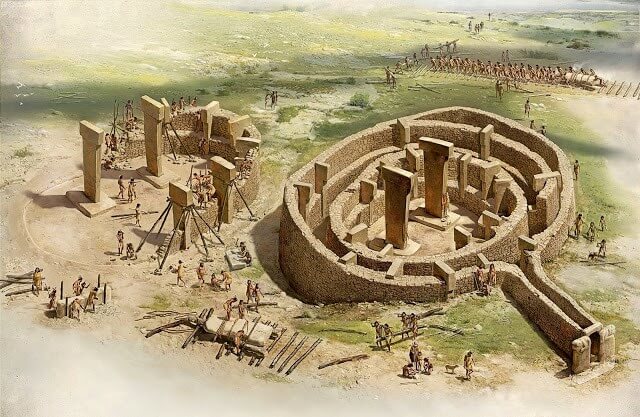
Gebeke Tepe
Where once families wandered with herds and seasons, they now built permanent homes beside fields. They formed villages, built granaries to store food through winter, shaped clay into pots, and began to worship together. Temples started to sprout too, the recently unearthed “Gebeke Tepe” built around 9600 BC depicts the advancements made be early farmer communities- some 4000 years before the Sumerians first reached southern Iraq, about 6000 years before first stones of Stonehenge and more than 7000 years before the first pyramids in Egypt started to appear.
The rivers that gave life.
The vast floodplain of Tigris and Euphrates is simply known as Iraq or Bilad al-Rafidyan in Arabic meaning the land of the two rivers. We know the land and people of the ancient time more commonly by Greek name, Mesopotamia; Mesos meaning between and Potamus meaning river. For thousands of years, the two great rivers carried slit from the Taurus mountains transforming not only the arid desert landscape but also the course of human history.
The hot and arid Mesopotamia is in fact the last place on earth, one can expect a civilization to begin. Other than the green patch in the southern delta created by the two rivers, south Iraq is virtually an inhospitable arid desert. There are no natural resources: no trees, no rocks, no minerals. The temperature is incredibly hot; the winds are wild and there is barely any rain.
The rivers often relied on the rainfall in the mountains and their flood path varied greatly. Years of rain often followed by years of draught. Early farmers, rather remained in the mountain foothills of north, where the rain was predictable and it was easier to farm with abundant resources. And so, before Sumerians and Akkadians made it their home Mesopotamia was just a land of clay and slit.
Migration to south: The Ubaid periods (6500 – 5500 BC).
For several millennia, farming remained mostly a highland affair. But after thousands of years in the mountain foothills, as both number of people and farming knowledge grew, they began to spread out looking for other arable lands.
Over milennia, the floodplains of the Tigris and Euphrates had transformed the barren desert of southern Iraq into fertile farmland. By around 6500 BC, a group of early explorers pushed southward drawn by vast fertile floodplains of the Tigris and Euphrates. We call this period between 6500-5500BC as “Ubaid period”, arbitrarily named after the site where their artifacts were first discovered.
These settlers adapted to their new world with remarkable ingenuity. With no trees, they built houses from bundled reeds gathered in the marshes of the southern delta. They made dams and dug the first irrigation canals, taming the rivers’ fickle floods and diverting the river to suitable farmland. They farmed wheat, millet, sesame and rye in their newly developed farmlands.
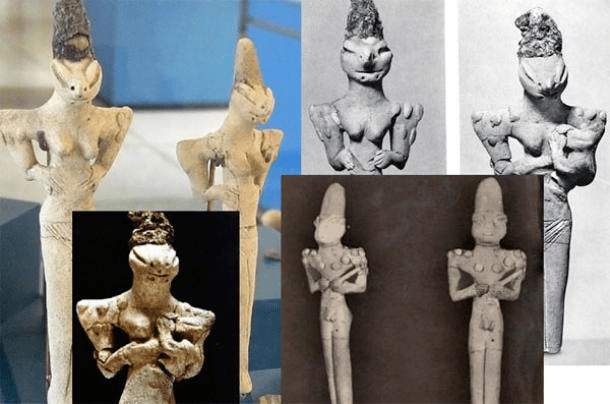
Ubaid Figurines (circa 6000 BC)
As they moved south, they would have noticed the palm trees with huge leaves and sweet fruit across riverbanks. Drawn by the shade it provided, they learned to plant them in their gardens and grew fruits like pomegranate and figs under them. They discovered pottery wheel and learned to craft pottery.
Who were these people, what language they speak, what belief they believed or what they called themselves remains a mystery. Whether they were the direct ancestors of the Semitic-speaking Akkadians who later emerged to the north also remains unanswered today.
Just like the two great rivers, two great people soon occupied the land between two waters. To the north were the Akkadians, speakers of a Semitic language who followed the Ubaid lifestyle. To the south, near the seacoast, lived the more mysterious Sumerians.
Living intertwined and parallelly to each other, these two groups of people would form a first true civilization in present-day south Iraq that lasted an astounding three and half thousand years, beginning around 5400 BC until it came to a final collapse in 1750 BC.
Sumerians: People running north after a disastrous flood swallowed their whole world.
The Sumerian version of history was dominated by a devastating event of apocalyptic proportions. According to Sumerian legends, their ancestors fled a catastrophic flood that engulfed their entire homelands. This “great flood” is perhaps the oldest continuously told stories in human history- later echoed in Babylonian, Hebrew, and even Greek myth.
The Tigris and Euphrates rivers flow for about two thousand kilometers today, from Taurus mountains before they drain at the Persian Gulf in south Iraq. Before the end of last glacial maximus (LGM) around 10000 BC, the Tigris and Euphrates did not end where they do today. Instead, they joined and in the southern Iraq. This single river would have flowed through what is now the Persian Gulf, traveling another six hundred kilometers before reaching the Indian Ocean near today’s Dubai.

Low Lying valley in Persian Gulf (circa 12000 BC)
That great river would have created a fertile floodplain between Iran and Saudi Arabia; a low-lying valley submerged under the present-day Persian Gulf. A group of neolithic people may have migrated down from the Iranian mountains in pre-history may have made this low-lying valley their home since ancient time, in complete isolation from those living in the fertile crescent.
As global temperatures rose by 4–7°C after the Ice Age, ice caps melted, and sea levels rose an astounding 120 meters worldwide between about 10,000 and 5,000 BC. This was also the time when the land bridge that once connected Europe with Britain, or Alaska and Siberia got buried by the rising sea.
The sea rose slowly at first but by the time it reached current levels around 5,000 BC, global sea levels had risen on average an astounding one hundred and twenty meters, devouring large pieces of land all around the world. For the people living in the low-lying valley of the present-day Persian Gulf, this rising sea levels was a disaster of apocalyptic proportions. The rising sea claimed land at an incredible pace, a meter every three days or about a hundred twenty meters every year, about a kilometers every ten years for 5000 years.
If there were humans living in this valley, the event must have been utterly devastating and people equally helpless. The next centuries would see these people migrate inwards to the north, as the encroaching waves that engulfed their whole forests and villages. They were pressed into ever denser population, forced to adapt as they moved one from one place to another before the sea made its next advance.
This exodus would have continued north until the temperatures stabilized and seacoast reached their furthest levels around 5500-5000 BC.
Sumerian problem: The strangers who spoke strange sound.
The Sumerians first arrived in southern Iraq between sometime between 5500 – 5000 BC, with tales of a devastating flood that had devoured their entire worlds at the time of their ancestors. The brought with him a language so alien, archeologists have long referred to it as “Sumerian Problem”.
Unlike Akkadian, Babylonian, or later Aramaic, languages from the Semitic family, Sumerian is what linguists call a “language isolate.” It shares no known relation to any other language on earth. The Sumerians had lived in isolation for so long that they developed their own language separate from sematic speaking people of north. Early scholars, puzzled by the first cuneiform tablets uncovered, believed them to be cryptic Babylonian records until they realized they had discovered something much older and entirely different.

Some have even suggested that they arrived on boats from faraway places like India. A Sumerian myth told of Enki, who created humankind in a distant land called Dilmun, thought to be modern Bahrain. Later Babylonian myths spoke of Oannes, an amphibious god who emerged from the sea to teach civilization’s secrets before returning to the waters.
Whether they arrived on boats from elsewhere or walked their way north from low lying valley now engulfed under sea remains unknown. It is possible that in these myths, the early writers have preserved some memory of the arrive of Sumerians in the southern Iraqi sea banks.
By around 5500 BC, as waves of sematic speaking people of north moved down from the mountains to the southern riverbanks, they met a group of flood ravaged people coming from the south. They came bearing tales of how their entire worlds being engulfed by rising sea and brought with them advanced culture and ingenious ideas.
The two groups of people settled parallel to each other like the great rivers; Akkadians on the north Sumerians in the south. They lived side by side, trading and borrowing ideas, sharing their successes and their failures. These would go on to form a symbiotic relation for the more than three and half thousand years, creating the first civilization in human history.
Birth of Civilization: The first Sumerian settlements.
According to Sumerian myths kingship first descended from heaven in the city of Eridu, founded around 5,400 BC near the ancient seacoast. At its height, Eridu may have housed 10,000 people, remarkable for its time.
While we don’t know much about their origin, we know a lot about how the Sumerians were and lived their lives. The Sumerians imagined the world as a circular landmass surrounded by bitter seas, with fresh waters from rivers and rain at its heart. They called their homeland Ki-en-gir (“land of the noble lords”). They spoke of their civilized land as “Kalam,” while “Kur” described the wild lands beyond.
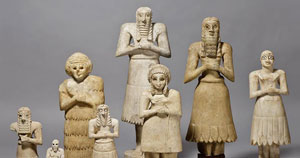
They called themselves, Uĝ saĝ gíg ga, or black-haired people distinct from Akkadians who settled in northern plains. From the carvings that depict Sumerians, we can see that they wore. Common men and women wore sheep skin kilts and copper and iron jewelries. The rich wore colored robes spun from wool and decorated with gold. They wore their hair curly on top and cut short on the sides.
They brought with them musical instruments, and remarkably we can still hear their music. Like everything else, they wrote their music down and instructions on how to tune and play their musical instruments.

Sumerian Cuneiform Tablet (Circa 3100 BC)
With few natural resources, the Sumerians built civilization from what they had. With clay, they made everything from cooking pots to sickles and writing tablets. They made bricks from mud, roofs from reeds. The houses were often made with complex arches and domes, where they often slept at night to escape the desert heat.
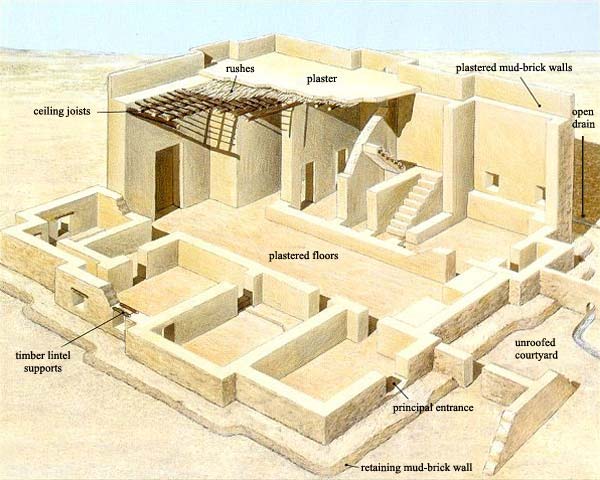
They refined the potter’s wheel, invented the plow and the wagon wheel, spun wool and fibers, learned to cast copper and later bronze and made sailboats.
They invented mathematics that we still use. The three hundred sixty degrees we use in measuring the angles of a circle is invention of the Sumerians. Their base- 60 system survives in our sixty-minute hours and sixty-second minutes. By counting the three segments on each finger of one hand, they reached twelve, then multiplied by five fingers to make sixty.
Their most transformative innovation, however, was irrigation. Vast networks of canals and dikes extended farmland, dams stabilized water supply and stored water creating surplus to survive dry seasons. This ingenuity transformed the desert: dams-controlled spring floods. Canals became trade routes, moving grain and goods.
Gradually the landscape of southern Iraq transformed from dusty desert and marshy swamps to green farmland. Due to this ingenuity, Sumerian society grew at a slow but steady pace.
Eridu: Birth of the first cities.
This ingenuity coupled with the necessity of harsh desert slowly gave rise to ever complex society of the Sumerians slowly started to rise. The digging of extensive system of water management required careful planning, engineering expertise and mathematical calculations. Workers needed to be organized and paid in food and beer. Foreman and overseers needed to be appointed, and all this led to early bureaucracy that gave rise to first true states.
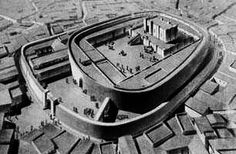
According to Sumerian tradition, the first city was Eridu. Founded around 5,400 BC near the Persian Gulf coast, it grew to around 10,000 inhabitants – a remarkable size for its time. Soon there would be a whole constellation of small cities along the southern Iraq. These independent cities were centered around their temples and ruled by priest kings, knows as Ensi. These Ensi were often assisted by council of elders that included both men and women.
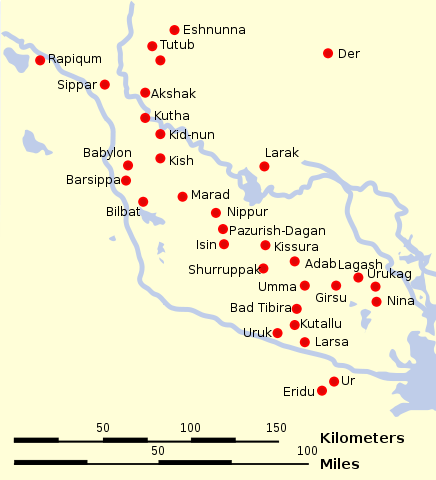
By about 5,000 BC, Sumerian cities eclipsed the older Ubaid culture. Remarkably, this early Sumerian era, known as the Eridu period (5400-3900 BC) remained largely peaceful for about 1,500 years. There is little evidence of warfare or professional soldiers, most town at this time went without walls. Yet as populations grew and wealth accumulated, inequality deepened. The first evidence of slavery surfaces in this period – a shadow that would lengthen over centuries.
In the next few hundred, the Sumerian people remained in relative isolation rarely venturing away from the ‘Kurs’ nearby. But as the cities grew, so did their innovations and explorations. Soon, they would invent writing, start venturing as far as Africa and India using their sail boats, trade with people from Cyprus to Afghanistan and make form grand metropolis like Ur and Uruk.
This next period in the Sumerian civilization, the Uruk Period (3900-2400 BC) would see Sumerian evolve from a primordial society into a first modern human civilization.
 kafkaintherun
Leave a comment