Sumer I: The Eridu Period.
In the beginning there was a great flood. Eridu was not built on conquest but on survival. After the flood, humans reshaped the desert with canals and clay, turning scarcity into storage, and floodplains into farms. It was here, in southern Mesopotamia, that the idea of civilization first took root.

Eridu: The City where Kingship Fell from Heaven.
According to the myth of Enki, the ancient homeland of the Sumerian-speaking people was in the land of Dilmun- a place like the garden of Eden, place of perfection, peace, and divine beginnings. Here, it is said, the god Enki created humankind in his own image. Dilmun is often identified with present-day Bahrain, a small island in the heart of the Persian Gulf. But the Gulf was a very different place during the last Ice Age. What is now a wide expanse of water was once a low-lying fertile valley, possibly inhabited by neolithic humans migrating downhill from Zagros mountains.

As global temperature rose by about 5 to 7 degrees between 10,000-5,000 BCE, the ice cap that had covered the entire northern hemisphere slowly began to melt. The sea rose- gradually at first, then with devastating force. By the time sea reached their current levels globally, it had risen by an astounding 120 meters. If people were living in this low-lying valley at the time, these encroaching waters must have seemed apocalyptic: forests drowned, villages washed away, coastlines swallowed whole.

Driven northward by floodwater, these displaced communities migrated inland, their lives upended, their stories shaped by catastrophic flood. Pressed into increasingly dense pockets of population, they were forced to adapt as they moved from one place to another, always ahead of the advancing sea. By 5,500 BCE, these migrants, who would come to identify as Sumerians, had arrived in the marshlands of southern Iraq. They carried with them both the trauma of the great flood and a legacy of ingenuity.

As they entered the fertile plains at the mouth of the Euphrates, they encountered Semitic-speaking peoples: the Akkadians who had already settled along the Tigris River and the northern uplands. The Akkadians received these southern newcomers not as enemies, but as partners. Over the following centuries, the two cultures would live side by side, like their rivers, in a symbiotic exchange of language, belief, and innovation.

The first city founded by the Sumerians was Eridu, around 5,400 BCE. According to a controversial Sumerian document called “The Sumerian King List”, Eridu was the place where "kingship first descended from heaven". At the center of Eridu stood the temple of Enki, which functioned as administrative hub. Priests acted as early bureaucrats, recording offerings, managing grain, and adjudicating disputes. With a population possibly nearing 10,000 by the early 5th millennium BCE, Eridu may have been the world’s first true city. For context: woolly mammoths still roamed parts of Siberia, and the first pyramids of Egypt were still three thousand years away at the time of Eridu’s founding.

While the Akkadians remained concentrated in the north, the Sumerians established a foothold in the south. Over the next few millennia, the two groups settled parallelly and shared their cities, temples, trade routes, and gods. Their myths blended, their scripts influenced one another, and their destinies became entwined. Together, they laid the foundations for the world’s first civilization in the land between two rivers: Mesopotamia.

Eclipsing The Ubaid Culture: The Rise of First City-States.
A Babylonian legend from the 1st century CE tells of Oannes, a half-man, half-fish who emerged from the sea to teach humanity the arts of civilization. He brought knowledge of letters, sciences, agriculture, and architecture- even the wisdom to measure land and build cities before jumping back into the ocean. While mythological, the story reflects a memory of real transformation during the early phase of human history.

In the beginning, farming was concentrated along natural riverbanks. The Sumerians brought with themselves advanced techniques and ingenious ideas that gradually transformed the area. Their mastery of canal-building turned seasonal floods into engines of growth. They constructed an intricate network of canals, levees, and dams to control the flow of water. These weren’t modest community projects; they were monumental undertakings that required planning, organization, and authority.

The first cities did not begin with walls or palaces. What shaped these marshland villages into cities was not the will of a king or the favor of a god- it was the irrigation canals. Communities in the late 6th millennium BCE began digging channels that diverted floodwaters into basins and fields. The labor demanded foremen, overseers needed scribes. There was no money at the time, but the workers still needed to be paid in food, beer, and shelter.

From this system emerged the earliest bureaucracies. The land, transformed by water, began to bloom. Dusty plains became green farmland; marshes turned to irrigated fields. The Sumerians had created an artificial ecology- and from that, the first city-states were born.

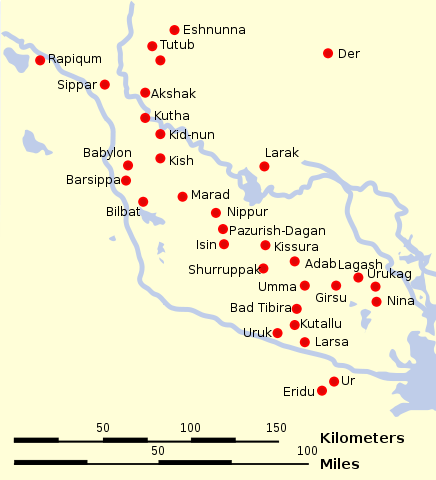
By 4,500 BCE, southern Mesopotamia was a mosaic of small cities. Each was centered around a temple that served both religious and economic roles. These cities, including Eridu, Uruk, Ur, Kir and Lagash, were independent but spiritually and culturally aligned. They were governed by priest-kings known as ensi, assisted by councils of elders, which sometimes included women, as seen in early Sumerian paintings.

This early Sumerian society was remarkably peaceful and cooperative. Their cities were not fortified; there is little archaeological evidence of warfare in this early period. The boundaries between these states would have been the irrigation canals. It was a civilization without armies or walls- one that prioritized irrigation over invasion. It would take another two thousand years before the first kings would emerge, or state wars.

Seeds of civilization: The Sumerian Imagination that turned desert into farmland.
The Sumerians called themselves Uĝ saĝ gíg ga- "the black-haired people"-distinct from the Akkadians. Carvings from the time show common men and women wearing sheepskin kilts and simple copper or iron jewelry. The wealthy wore woolen robes dyed in vivid colors and adorned with gold. Hair was worn curly on top and cut short on the sides.

In the next few hundred years, with their ingenuity and discipline, Sumerian culture gradually eclipsed the older Ubaid culture. Their myths, rituals, and technologies shaped a new identity. One Sumerian text, "The Gifts of Inanna", describes how the goddess received from her father, Enki, the tools of civilization:
"Holy Inanna received the craft of the carpenter, the craft of the coppersmith, the craft of the scribe, the craft of the builder... Holy Inanna received wisdom, the shepherd’s heart."

This was not mere poetry, Inana then passed those secrets to people of Sumer. With little access to stone or timber, they made do with what they had- abundant clay and reeds. From these, they crafted everything: cooking pots, sickles, musical instruments, even writing tablets. The Sumerians invented or refined the plow, the wagon wheel, and metallurgy. They spun wool, dyed textiles, and brewed beers. They developed the slow-turning potter’s wheel and produced elegant ceramics. In the Eridu period (5,400 – 3,500 BCE), their pottery was intricately decorated with geometric patterns that gradually faded in the Uruk period (3,500- 2,400 BCE).

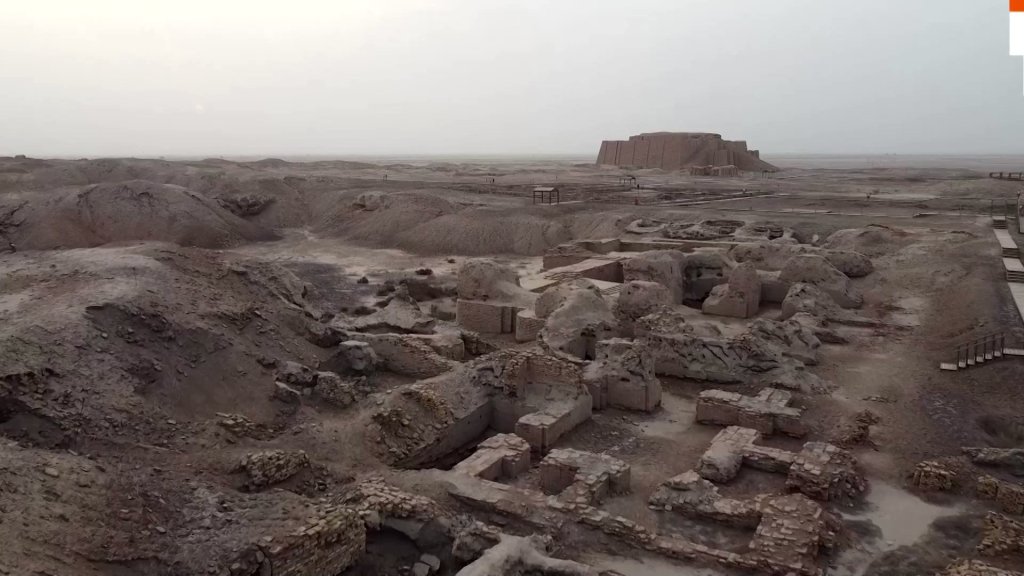
They bundled reeds into planks to sailboats and houses. They learned to fire clay to make bricks- used them to build homes, temples, and public buildings. Their architecture showed an early mastery of form and function. Mudbrick houses often featured courtyards, complex arches, domed roofs, and vaulted halls. Central temples were often the tallest and most imposing structures in the city. Temples rose above the flat plains, often built on elevated platforms, marking both sacred space and administrative center.

They brought with them musical instruments whose melodies we can still reconstruct. They invented mathematics we still use. They were the first to turn fingers in hour into numbers. Their base 60 number still survives today in the 360 degrees in angle system, the sixty minutes in an hour, the sixty seconds in a minute. Clay tokens and counters were used to track quantities- of grain, sheep, oil- long before writing proper emerged. Sumer. In the next centuries, they went on to develop addition subtraction and multiplications.

Despite environmental challenges, early Sumerian diets were diverse and nutritious- arguably better than in the later Bronze Age. They cultivated wheat, millet, lentils, peas, dates, and pomegranates. They raised goats and sheep for milk and cheese and fished the marshes. This abundance of food helped sustain trade and population growth. City like Ur would become leader in global trade by the middle of 3rd millennium BCE exporting this surplus of grains, legumes, vegetables, and fish provided not just sustenance but stability and play a city of Ur becoming the global leader of maritime trade by 3rd millennium BCE.

In the ancient Enki gave his daughter Inana gift of knowledge and good judgments, but he also gives her other gifts. Even at civilization’s dawn, darkness and barbarism were taking root. “Holy Inana received deceit and the rebel lands. Holy Inana received heroism, power, wickedness, the plundering of cities and the making of lamentations”. During Eridu’s height, a sorrowful phase of human history was about to take shape- the use of the slave labor. They captured men and women from hill countries and used them as slaves to fuel their own growth.

The next steps: Rise of metropolis and shift to Uruk (Uruk Period 3,500-2,400 BCE)
As centuries passed, Eridu remained sacred but was eventually overshadowed by urban metropolis like Uruk by middle of 4th millennium BCE. But before temples grew into ziggurats and myths into epics, it was in places like Eridu that the architecture of civilization was first imagined. Not in grand declarations, but in the steady digging of canals, the shaping of mudbrick, and the gathering of people who, for the first time, stayed. From a marshy corner of southern Mesopotamia, these black-haired people engineered not only a livable world, but a blueprint for civilization.

Eridu wasn’t just a place where people lived. It was a place where they organized, mythologized, and remembered.  And though the center of power would eventually shift- to Uruk, where writing and monumental architecture would explode - Eridu remained in the Sumerian imagination. Later would come Epic of Gilgamesh and confusion of tongues, tablets and taxes and epics carved in clay. In Eridu, we see something quieter and more elemental: the moment human life crossed the threshold from scattered village to sacred center.

Long before Uruk etched its mark on stone tablets, Eridu stood alone by the Euphrates- low, ancient, half-remembered. Even after thousands of years, Sumerian kings would list Eridu first in their dynastic chronicles. In their minds, as in their myths, this is where it all began.



 kafkaintherun
Leave a comment