“He who saw the Deep, the foundation of the land,
who knew the ways, was wise in all things.”

So begins The Epic of Gilgamesh- a tale of kingship, grief, immortality, and a flood that once swallowed the world. Written around 2800 BCE, it is the oldest surviving piece of literature in human history. Its central figure is Gilgamesh, a king of Uruk who had risen to semi-divine stature even before the poem was composed. This city the epic is based on, the city Uruk, would go on to become the cultural and political heart of Sumerian civilization in the 4th millennium BCE.

The Rise of the First Metropolises: Uruk and the World It Shaped
As sea levels stabilized around 5000 BCE, the southern coastlines of Mesopotamia began to change. What had once been coastal marshes turned into salt flats. Meanwhile, further north, Uruk- strategically located near the convergence of rivers and canals- began to thrive. Long before it became the setting of the world’s first great epic, Uruk was slowly replacing Eridu as the spiritual and economic center of Sumer. The verses of Gilgamesh would come later -when kings were mythologized and floods became metaphors.

In the 4th millennium BCE, power began to shift in the city states. Where priests once governed city life, clan leaders and emerging kings now ruled. The period that followed- known as the Uruk period, named after the city, itself- saw the rise of city-states led by secular rulers. By the middle of the 4th millennium BCE, Uruk had become one of the largest and most influential cities in Mesopotamia, with a population of over 50,000- larger than any city the world had yet seen.

Archaeologists now link the drastic stylistic shift in pottery during this time with the cultural handover from Eridu to Uruk. Pottery from the earlier Ubaid and Eridu periods was refined and attractive, made using the slow-wheel technique and painted with intricate geometric patterns. These vessels were expensive and primarily used by elites.

In Uruk, potters developed a new technique: the fast wheel. This allowed mass production to meet the demands of a growing population- but at the expense of quality. While pottery declined in craftsmanship, life improved in other ways. For the first time in human history, people were no longer limited to eating only what they produced. Boats navigated rivers and canals, carrying food and goods from neighboring regions. During this period, Sumerians also began venturing beyond their homeland- into Babylon, Elam, and even the Turkish and European highlands.

This was more than five thousand years ago. By then, Sumerian civilization was already two thousand years old- a timespan that separates us from Julius Caesar. Yet the first Egyptian pyramids wouldn’t rise for another nine centuries, and the first stones of Stonehenge wouldn’t be placed for another thirteen hundred years.

The First Light in Human History: Writing Is Invented in Uruk (3200 BCE)
When gas clouds compacted by their own weight obtain enough pressure and gravity, the first stars burst into becoming. When enough people gather in one place, that settlement obtains a kind of gravity- It draws other people towards it. As size of settlement increases, so does pressure on its various systems. By the middle of the 4th millennium BCE, as Uruk expanded into a metropolis, its population density- and the complexity of their interactions- gave rise to an even more complex form of human organization.

The first stars of human settlement began to burst into light in Uruk, sometime in the year 3,200 BC. A later Sumerian epic, Enmerkar and the Lord of Aratta, attributes this invention to the “Lord of Kullaba,” a king overwhelmed by too many messages for his messenger to remember:

“Because the messenger’s mouth was heavy and he couldn’t repeat the message,
the Lord of Kullaba patted some clay and put words on it like a tablet.
Until then, there had been no putting words on clay.”

The Sumerians had two things in abundance: clay beneath their feet, and reeds growing by the riverbanks. These came together to form humanity’s first writing system. Scribes would pat a lump of clay into the size of a modern smartphone, cut a reed into a wedge, and press it into the surface to make symbols. The distinctive wedge shapes gave the script its name: cuneiform.

The earliest cuneiform signs were pictographs- simple images to depict everyday objects so that anyone could interpret. A fish meant fish. A scratched circle stood for a head of cattle. A jar symbolized oil. Initially, they were used to keep track of supplies, taxes, and rations. This pictographic system, known as proto-cuneiform, emerged around 3300 BCE. The first records may have been dry- lists of goats, measures of barley, allocations of beer- but their implications were monumental.

The oldest excavated cuneiform tablet dates around 3,200 BCE. A bowl of food is depicted with and eating mouth next to six impressions, and sheaf of wheat next to five. This indicates that the worker can exchange this tablet for six bowls of food or five sheaf of wheat. The scribes would have had to work fast, copying hundreds of documents every day.

Overtime, these pictographs became increasingly simpler and more abstract, as scribes developed shortcuts and standardized signs. Before long, they no longer looked like the object they described. By the start of the 3rd millennium BCE, the number of signs had shrunk from over 1,500 to around 600. Around the same time, someone had a bright idea that each symbol could stand for a certain sound, instead of the whole idea. This was the beginning of first alphabet.

But with this innovation came exclusivity and gave birth to class of scribes. Only an educated class of scribes could understand these new signs. A profession was born. The human brain would never be the same. For the first time, knowledge could outlive speech and memory.

As the clays dried, the letters remained etched in history. It is why we can still play their music and read their epics. People could hear and read about kings and scribes who had died hundreds of years before. Authority could now be transferred, not just told. They could also begin to write down everything they had learned so that it can be remembered but more importantly it could be built upon. Partly due to this ability to develop knowledge, the technology of Sumer would begin to take even greater leaps in this next phase in history.

Uruk at Its Zenith: Epic, Empire, and Everyday Life.
By 3000 BCE, Uruk was the epicenter of Sumerian administration, agriculture, and ritual. Its scribes had etched thousands of tablets. Its merchants ferried goods across rivers and marshes. Its temples served as banks, warehouses, and courts.

It is in this city that The Epic of Gilgamesh begins- the world’s oldest literary text. Its hero, two-thirds god and one-third man, Gilgamesh may have been a real king who ruled around 2700 BCE.

Though the epic is more myth than history, it reveals how life in Uruk was changing during the early 3rd millennium. For one, warfare began to intensify in the region. City-states now required walls. In the epic, the walls of Uruk is described with great pride repeatedly referencing as ‘Strong Walled Uruk”.  Gilgamesh’s narrator calls out:

“Go up on the wall of Uruk and walk around,
examine its foundation, inspect its brickwork thoroughly.
Is not (even the core of) the structure made of kiln-fired brick?
Did not the Seven Sages themselves lay out its plan?”
- The Epic of Gilgamesh, Tablet I

We also get a sense of how the city was divided during this time, suggesting some level of urban planning from its rulers. In the Epic of Gilgamesh, we can find how the city of Uruk was designed:

“These parts comprise Uruk:
one third for the city,
one third for garden,
one third for field and the precinct for temple of Ishtar.”

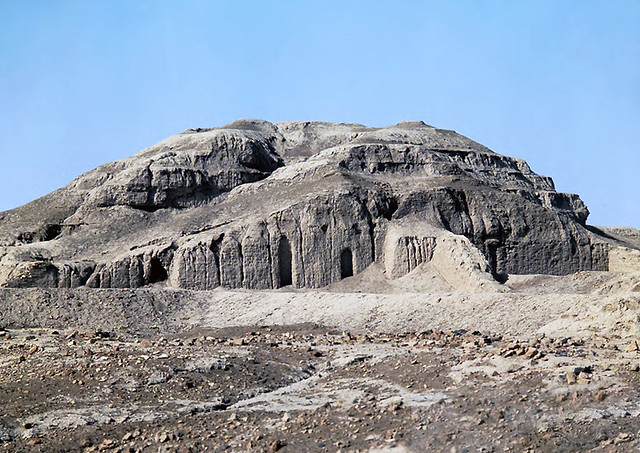
It had a port on the river, along with workshops and cluttered houses. At the center of the city was, Uruk’s famous White Temple of Ishtar. It was elevated 21 meter and covered in white plaster that made it glow during the day. At the height of Uruk period, the city covered an area of 2.5 square kilometer and had a population of more than 50,000 people.

The rich part of the town would have houses built with baked bricks, elsewhere they would be made from sundried clay.  The affluent neighborhood would have houses with complex arches and domes. In their houses, people laid down layers of clay, crushed gypsum dust and reed mat to create carpet like effect.  At night people usually slept on their rooftops, since the heat inside the houses would have been too much for them.

The city would have been a pungent mixture of smell. Pottery kilns and brickworks would have belched smoke throughout the day. There was no drainage system, and people would have thrown their trash into the streets. The houses would have been arranged in chaotic way, creating a labyrinth of alleys which would have been covered with reed matting to keep them cool in the heat of the day.

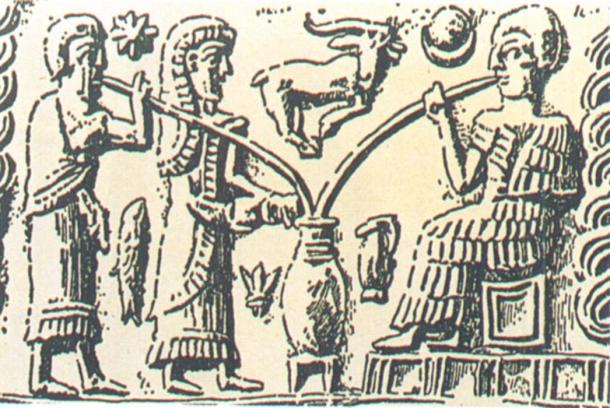
The streets of Uruk during this would have shops with produces such as lentils and beans, pomegranate and dates, jars of syrup and oil etc. Farmers would be carrying large bundles of reeds and wheat on their backs. Herders would bring their long-haired sheep and oxen into the city. Men would often be found sitting in circles in shaded courtyards, sharing large jar of beer in the center, all shipping it with straws made from hollow reeds. While the Sumerians knew how to make Wine, it was beer they loved most.

Brewed directly from wheat and millet, they had more than 30 different varieties of Beer- white, dark, cloudy, flavored with herbs, sweetened with honey etc. The cheaper kind would still have grains floating. One Cuneiform tablet from early 3rd millennium BCE still preserves one of their drinking songs:

"I will summon brewers and cup bearers to serve us floods of beer and pass it around.
What pleasure! what delight!
Blissfully to take it in.
To sing jubilantly of this noble liquor.
Our hearts are enchanted and soul radiant."

Like the details about their musical instruments, the conversations of ordinary Sumerians are also remarkably preserved. Form the cuneiform tablets, we can read that they conversations they would have in their courtyards and bars around their jars of beers. Some of these everyday concerns are preserved in their tablets, and they are no different than ours.

In one tablet one-man laments “I am a thorough breed stead, but I am hitched to a mule.”  The poor were downtrodden, often having the need to burrow food and silver from predatory lenders.  A cuneiform tablet captured the plight of poor “The poor men is better dead than alive, if he has bread he has no salt, if he has salt, he has no water."

There was no money at the time, workers were paid directly in food and other goods. The minimum ration of an unskilled worker would have been twenty liters of barley per month along with two liters of oil and two kilos of oil per year. Meanwhile their supervisors would earn twice as much.

This period was also the dawn of mass production. Sumerian clay tablets of this era tell tales of the blooming economy during this time. They tell us, in the city of Girsu for instance fifteen thousand women were employed in textile industry. One factory produced eleven hundred tons of flour a year as well as bread, beer and linseed oil. This factory employed 134 specialists and 858 skilled workers, of which the vast majority were women.

The city of Ur and the Bronze age.
The period of Uruk sent ripples across the world, and several similarly great cities would rise around it. As the 3rd millennium BCE began, another Sumerian city was rising in power. As the 3rd millennium progressed, one city- Ur- would surpass Uruk in power and prestige. Positioned at the confluence of river and sea, Ur would become a hub of maritime trade and a beacon of art and architecture. The world was entering the Bronze Age, and Sumer’s legacy would now sail farther than its rivers had ever flowed.




 kafkaintherun
Leave a comment