


All eels on earth begin their life at Saragossa Sea, a small patch of Atlantic Ocean near Bermuda Triangle. How a river-dwelling fish is tied to an oceanic cradle millions of years older than humanity.
What Exactly Is an Eel?
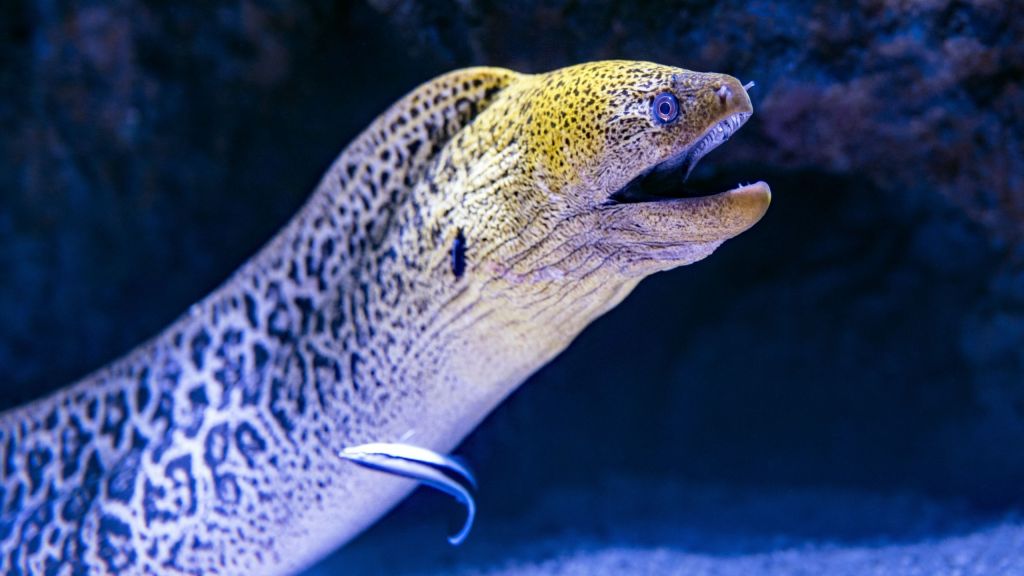
At first glance, an eel looks like a snake that somehow learned to breathe and live underwater. In reality, it belongs to Anguillidae, a family of elongated fishes shaped by a life lived between fresh water and salt. Eels have a slender, ribbonlike body, reduced or absent pelvic fins, and sensitive pores that let them detect faint chemical and electrical cues in murky rivers. Long, muscular, and fluid, they move with an ancient ease. Unlike snakes or lampreys, they have jaws, bones, and gills like any other fish.
For most of their lives, sometimes seventy or eighty years, they inhabit lakes, streams, ponds, and wetlands. But their presence in freshwater is only temporary. They begin life in the ocean, grow in rivers, and eventually return to the sea to reproduce. Everything about their biology points toward a destination hidden far from the continents.
A Reproductive Mystery
The most astonishing fact about eels is that no scientist has ever witnessed their mating in the wild. For centuries, the absence of visible reproductive organs in freshwater eels baffled naturalists. In this stage of their lives, the gonads are undeveloped and nearly invisible, giving the illusion that the animals are sexless. Aristotle concluded that eels must arise spontaneously from mud because no eggs, breeding grounds, or spawning rituals were ever seen.
Yet after years or decades of inland living, something remarkable happens. Without warning, the eel’s skin turns metallic silver, its eyes enlarge for deep-ocean vision, and its digestive system collapses. From that moment onward, it will never eat again. Its entire body reshapes itself for a single purpose: to leave the rivers and cross the Atlantic back to the Sargasso Sea, a place it left as a larva but will return to with astonishing precision. Navigation relies on the Earth’s magnetic field, a sense that functions like an internal compass scientists are only beginning to understand.
Almost everything we know about their reproduction comes from indirect evidence: the size of larvae caught at different distances from the Sargasso, the physiological changes in migrating adults, and the movements of major ocean currents. Mature eels swim thousands of kilometers to this same gyre, release eggs and sperm into the open water, and die soon afterward. Their bodies are never recovered. Their transparent offspring begin drifting outward again, continuing a cycle as elegant as it is mysterious.
Why the Sargasso Sea? An Origin in Deep Time
Every freshwater eel on Earth, whether European, American, or Asian, begins its life in the same region of the western Atlantic. To understand why, we must step far outside human history and into the ancient geography of oceans.
The story begins more than fifty million years ago, when the world’s seas were arranged differently and the lineage of eel-like fishes was emerging. Modern freshwater eels, including Anguilla anguilla in Europe and Anguilla rostrata in North America, descend from marine species whose larvae drifted long distances on warm currents. The remarkable leaf-shaped leptocephalus larva that exists today is a living remnant of this early oceanic lifestyle. It is not an adaptation to rivers, but a survival strategy born in open water.
As the Atlantic widened and the Sargasso gyre formed, a unique environment appeared: warm, calm waters with few predators and floating mats of Sargassum weed. The circular current system acted like the hub of a wheel, sending tiny larvae outward toward the coasts of Europe, North America, and the Caribbean. Species that spawned there gained a strong advantage. Their larvae were dispersed reliably into productive coastal habitats where they could grow safely.
Over millions of years, some of these marine lineages began using rivers as feeding grounds while retaining their ancestral habit of spawning in the ocean. Evolution did not replace their original strategy but added a freshwater chapter to it. Genetic evidence shows that American and European eels split roughly three to six million years ago, long after the Atlantic gyre had settled into its modern form. This means their connection to the Sargasso predates their entrance into rivers.
Rivers offered abundant food and fewer competitors, allowing juveniles to grow larger. But the reproductive strategy remained unchanged. Natural selection favored those that returned to the gyre because larvae born there were carried reliably by the Gulf Stream. Gradually, spawning in the Sargasso became fixed in their biology.
The Journey and Transformation
As the migration begins, adult eels stop eating entirely. Their stored fat becomes both fuel and the resource for developing gonads. In the final months of the journey, their eyes enlarge, their skin brightens, their muscles reorganize, and their endocrine system shifts into a reproductive phase that only saltwater migration can trigger. No freshwater environment can induce these changes.
When they reach the Sargasso, they spawn at depths estimated between 400 and 1,000 meters. Fertilization occurs externally. The newborn larvae drift for months, feeding on marine snow and dissolved organic matter. The Gulf Stream slowly carries them toward the continents, where they become transparent glass eels, then pigmented elvers, and finally the yellow eels that live in rivers.
Modern research supports this ancient cycle. The smallest eel larvae ever found, only millimeters long, have all been collected within or at the edges of the Sargasso Sea. Their size increases outward from the region in a perfect pattern of radial dispersal. Satellite tagging, otolith chemistry, and DNA all confirm the same conclusion: adult silver eels migrate into the gyre, spawn, and die.
The Sargasso’s magnetic signature is distinctive. Larvae imprint on it, and adults use this imprint as a navigational map. Experiments show that eels reorient themselves in artificial magnetic fields exactly as they do in the Atlantic. Other ocean gyres exist, but none align so precisely with the continental shelves where juveniles thrive.
Salmon: A Mirror Strategy in Reverse
The eel’s story becomes even more striking when compared with salmon, another migratory fish with a terminal reproductive run. But their strategies are almost exact opposites.
Salmon are born in freshwater, migrate to the ocean as adults, and return to the exact river where they hatched. Their homing ability depends on smell. Juveniles imprint on the chemical signature of their natal stream and later track it home.
Eels, by contrast, imprint not on rivers but on the magnetic fingerprint of an ocean basin. They do not return to a specific waterway but to a moving coordinate defined by currents and Earth’s magnetic field. While salmon require the structure of a river to protect their eggs, eels benefit from the Sargasso’s warm, nutrient-poor emptiness, where predators are few and larvae can drift safely.
Both fish die after spawning. Both travel extraordinary distances. Yet where salmon solve reproduction by returning to a fixed point on land, eels solve it by returning to a floating, shifting nursery that has existed for tens of millions of years.
A Choreography Older Than Ice Ages
Every eel alive today is reenacting a pattern shaped by geology, ocean physics, and evolution. When a mature eel leaves its river and disappears into the Atlantic, its body is responding to a program written in deep time. It is following currents, temperatures, and magnetic cues that remained stable while ice ages advanced and retreated above.
The mystery endures not because eels are unknowable but because their story feels improbable. A fish that lives in rivers yet belongs to the open Atlantic. A species that begins life in calm, algae-ringed waters far from any land. A creature that carries within its body the memory of oceans older than our continents’ coastlines.
To understand eels is to accept that their true home lies thousands of kilometers away, in the quiet center of the Sargasso Sea, where this ancient evolutionary agreement still unfolds in darkness every year.

 kafkaintherun
Leave a comment