

How an island of stone circles and blue-painted warriors first felt the Roman Eagle. Tale of How Rome First Reached the British Shores.
Four centuries after Rome left, the Saxons who lived among its ruins called them enta geweorc– the work of giants. Long before the Eagle arrived, Britain was a land of Stonehenge builders and blue-painted warriors. Then came the storm-wrecked expeditions of Julius Caesar, a century of invasions planned and abandoned, and the mad emperor Caligula, who marched an army to the Channel only to wage war on the sea and gather its shells.
The Work of The Giants.
If you have ever watched the television series Vikings, you may remember a quiet scene in which the monk Athelstan and King Ecbert of Wessex stand together in the shadow of old Roman ruins. Looking up at the massive stone arches, Ecbert asks how any human hand could have shaped something so perfect.
Athelstan answers that his people call these ruins the enta geweorc- the “work of giants”. This phrase in Old English says it all.

“And did they?” Ecbert presses. “Were they giants, Athelstan?”
“No,” the monk replies. “They were men like us, Ecbert. But they were men who did not have to look to their own defenses every time the moon waxed full. Their hearts were beating for a city a thousand miles away that had already forgotten them, and that was their undoing.”
“If they were men, then the knowledge is not magic,” Ecbert says. “It is merely lost.”
“It is a paradox,” Athelstan whispers. “They built the most formidable fortress in the world, and then they abandoned it to chase a crown they could not hold. They left us their stones, but they took the light with them. Now we are scavengers in a graveyard of giants, trying to remember how to be men again.”
The Roman Eagle ruled these islands for nearly four hundred years, from roughly 43 to 410 CE. By the time Ecbert became Saxon king of Wessex, the occupation of Britain was so far in the past that ordinary people could no longer believe a human hand had laid those stones. To the Saxons, farmers who lived in simple wooden huts, Roman engineering was so advanced that it looked like the work of a vanished race of titans.
For Ecbert, who would unite much of England four centuries after the fall of Roman Britannia, the ruins were more than crumbling masonry. He did not see arches; he saw a blueprint- a record of how an empire had once controlled every inch of this land through organization and engineering that his own people could no longer replicate.
This “work of giants” sets the stage for our journey: an island forcibly turned into an imperial jewel and then left to rot until the locals could no longer read the walls they lived among. But to understand the story of Roman Britannia, we must first look past the Eagle, into the island’s true prehistory.
I. The Neolithic Northerners- Builders of Stonehenge

Long before the first Roman legionary set foot on its shores, Britain was a land of deep primeval forests and chalky highlands. By the late Iron Age it was home to the painted warriors the Romans dreaded- the same, blue-stained tribesmen who had been raiding into Gaul for generations. But the human story of these islands begins thousands of years earlier.
People first drifted north as the glaciers retreated, around 12,000 BCE. Britain was not yet an island. For the next six millennia it remained a peninsula of Europe, joined to the continent by a vast, low-lying land bridge known to modern archaeologists as Doggerland.
Around 6,000 BCE, rising seas finally drowned that bridge, severing the inhabitants from the mainland and carving the English Channel out of memory. The people left behind were a hardy mix of hunter-gatherers. In time, the first Neolithic farmers arrived in small boats, bringing wheat, cattle, and a knowledge of the seasons. They were a people deeply attuned to the cycles of the earth, surviving the brutal northern winters through grit and communal labor.
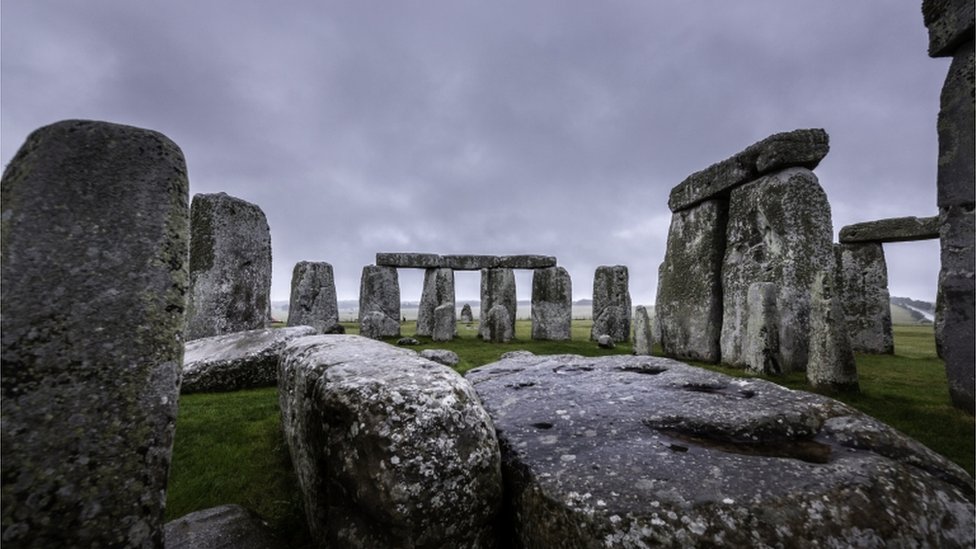
They did not just inhabit the land; they marked it. They dragged stones the size of barns across hundreds of miles to raise monuments that still defy easy explanation. The most famous is Stonehenge, built in stages from around 3,000 BCE. The alignment of its trilithons with the midwinter and midsummer solstices reveals an advanced grasp of the heavens- a calendar in stone for a people whose lives were dictated by the turning of the year. What ultimately happened to these Neolithic builders remains one of prehistory’s great open questions.
II. The Painted Isle- Ancient Britons of the Iron Age

By the time the Iron Age Britons inherited this land, the megaliths were already holy mysteries- silent stones that had stood for thousands of years. These ancient Britons were a hardy, tribal people who outlasted the island’s brutal winters in timber-and-mud roundhouses. Led by the Druids, who served as their judges, scholars, and priests, they lived in fortified hilltop settlements and were legendary for their terrifying appearance in battle: tall, lime-washed hair, gold torcs at the throat, and bodies stained blue with woad.
Long before the Roman Eagle saw them face to face, the people of Gaul and mainland Europe had been trading stories about the island and its inhabitants since the early Bronze Age- its tin mines, its brilliant pottery, it’s strange priests who held the power of life and death in the sacred groves. Soon this wild, blue-stained world would collide with the most efficient war machine the ancient world had ever produced.
III. Julius Caesar and the First Roman Encounters (55–54 BCE)

The shadow of the Roman Eagle first reached for the island in 55 BCE, driven by the ambition of Julius Caesar. Fresh from his bloody campaigns in Gaul, Caesar viewed Britain as more than a legendary mystery. It was a strategic nuisance: the British tribes were quietly sheltering and reinforcing their Gallic cousins, and Caesar meant to sever that lifeline- while burnishing his own glory in the process.
His first expedition was a logistical nightmare. The English Channel, with its terrifying surges and unpredictable tides, nearly swallowed his fleet before it could even land. When the Roman legionaries finally reached the shore, they were met by a sight that would haunt their nightmares: thousands of blue-stained warriors, screaming and waiting for them in the surf. Caesar carved out a temporary foothold but was quickly humbled when a North Sea storm smashed his anchored ships at their moorings. He limped back to the mainland with little more than a handful of hostages and a bruised ego.
Undeterred, and desperate to erase the embarrassment, he returned a year later in 54 BCE with a force the world had never seen cross those waters: eight hundred ships and five veteran legions. This time he pushed inland, crossed the Thames, and forced the powerful tribal leader Cassivellaunus to sue for peace. It was a tactical victory and a strategic failure. Caesar exacted promises of tribute and built thin diplomatic ties, but brewing instability back in Rome and a massive revolt in Gaul forced him to withdraw every last soldier. Britain slipped out of his hands as cleanly as it had slipped in.
Eight hundred ships, five veteran legions- and still Britain refused to stay conquered. Caesar’s campaigns were a reminder that the Channel was not a river to be crossed; it was a moat around a world of its own.
IV. The Century of Silence, and Caligula’s Seashells (54 BCE–40 CE)

Britain remained an unconquered “client kingdom” in all but name for the next century. During this long century of silence, the Emperor Augustus planned several invasions, each one quietly cancelled before a single ship was launched. Augustus learned what Caesar had only suspected: the Channel was a moat, and Britain was a problem easier to admire from a distance.
Then came the strangest chapter in the whole prologue, and it belonged to the Emperor Caligula.
Volatile, eccentric, and by every contemporary account half-mad, Caligula could have annexed Britannia if he had simply been a more stable man. In 40 CE he amassed a colossal force on the coast of Gaul- by some accounts as many as two hundred thousand troops, drawn up in full view of the Channel and seemingly prepared to finish what Caesar had started a century earlier.
To grasp what happened on that beach, you have to understand what kind of emperor was standing on it. Even by the brutal standards of Roman power, Caligula’s reputation was something apart. He had taken the throne in 37 CE as a popular young prince, the son of the beloved general Germanicus, and for a few months Rome adored him. Then, barely six months into his reign, a serious illness nearly killed him. By every ancient account, the man who climbed out of that sickbed was not the one who had climbed in.
What followed was a four-year carnival of cruelty and self-deification. He forced his teenage cousin and co-heir, Tiberius Gemellus, to suicide. He exiled his own sisters on charges of treason. He demanded to be worshipped as a living god in his own lifetime, ordered his statue erected inside the Temple in Jerusalem, touching off a near-revolt across Judea. He is said to have appointed his favorite horse, Incitatus, a priest of his own cult. Suetonius records his favourite line, lifted from an old tragedy and aimed at his terrified senators:
“Oderint dum metuant. Let them hate me, so long as they fear me.”
Within months of the beach at the Channel, his own Praetorian Guard would cut him down in a palace corridor. So, it is against this backdrop- a god-emperor who picked fights with the sea, the senate, and his own family- that we have to read what happened next on the shore of the ocean.
Then, at the water’s edge, something inside him snapped.
In one of the most bizarre displays in military history, Caligula reportedly lost his nerve as he stared across the Channel. Instead of boarding the ships, he commanded his confused legions to charge the waves with their swords drawn, and then to fill their helmets with seashells. These shells, he announced, were the spoils of his conquered ocean. He had the trophies displayed in Rome.
“Spolia oceani. The spoils of the conquered sea.”
The invasion was aborted. The legions went home bewildered, the senators went home embarrassed, and Caligula went home to be murdered within the year. But the months of troop-massing on the Gallic shore had done one thing his sanity could not: they had built a psychological bridge across the water. The next emperor who looked north would no longer be able to pretend the island wasn’t there.
The empire would come for Britain at last, but it would not be the man who stared down the Channel who brought it. That story belongs to a stammering, mocked outsider; to four battle-hardened legions wading through the marshes of Kent; and to a creature no Briton on the island had ever seen in his life.
But that is a tale for the next part.
Next › Roman Britannia Part II: The Birth of Roman Britannia
How a stuttering scholar-emperor finished what Caesar couldn’t- and what happened to an island that refused to stay conquered.
 kafkaintherun
Leave a comment