


Japan’s imperial family once had a custom of marrying only within four particular families. Lasting nearly eight hundred years, the practice left imperial family members shorter on average than other Japanese.
This article was first published in Nepali on Ukaalo on December 4, 2025 (Mangsir 18, 2082 BS). This is the author’s own English translation. Read the original: https://www.ukaalo.com/news/30923/
We humans have come this far by surviving many kinds of catastrophe over our evolution. Having split from the common ancestor we share with the other primates, the apes, nearly 5 million years ago, we are very new compared with many other species in nature. We became modern humans by enduring the genetic bottleneck caused by the Toba volcano and climate change, the harshness of the Ice Age, and countless geographic hardships and barriers. Our species, Homo sapiens, emerged only about 300,000 years ago.
Genetic Diversity Narrowed by Endogamy
We made it this far by weathering harsh external conditions, but humankind has also built countless walls within itself, further narrowing our genetic diversity. In my previous article, I explained why human genetic diversity is lower than that of other animals. The practice of protecting the purity of one’s lineage and community, carried on in various guises since the dawn of civilization, has also increased the risk of a range of hereditary diseases.
Our ancestors spent much of the primitive age as hunters. For a long time, our evolution proceeded without these boundaries. Only after a woman from a hunting group living around Turkey’s Taurus Mountains first learned to farm, nearly fifteen thousand years ago, did ‘civilization’ begin. As civilization expanded, the desire to maintain ‘ties’ with one’s clan, religion, caste, community, or royal line became part of our nature.
We began marrying within our own clan, caste, community, and religion (endogamy). The genetic diversity that nature’s randomness increases was steadily narrowed by such boundaries as society developed. But a tradition begun to protect the identity and purity of a community or lineage has, over time, become a genetic prison. Here is the paradox of our evolution: the farther we spread geographically, the more we narrowed our genetic diversity through geographic, social, and cultural structures of every kind. This harmed the development of humankind.
As kingship took hold in ancient civilizations, the tradition of marrying within one’s own family to preserve the purity of the royal line also began. This practice of marrying within one’s own family or among close relatives-first among kings and later among ordinary people as well-further reduced our already limited genetic diversity, and several genetic diseases appeared as a result.
A tradition begun to protect the identity and purity of a community or lineage has, over time, turned into a genetic prison.
Tutankhamun’s Tomb and the Evidence
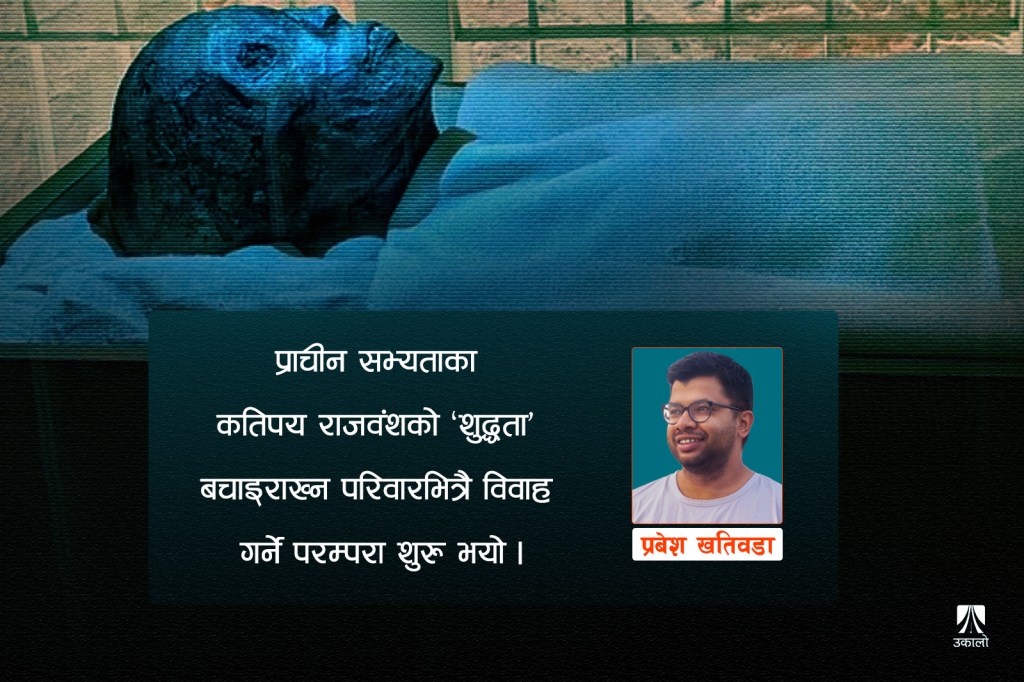
Many people interested in ancient Egypt will have heard the name ‘Tutankhamun.’ Tut was briefly king (pharaoh) of Egypt. After his death, the tomb containing his mummy (a body preserved so it would not decay for a long time) lay sealed in the desert for nearly four thousand years. Archaeologists found it ‘just as it was’ in 1922. It was the first pharaoh’s tomb untouched by robbers, which is one reason his name is so well known. Behind his fame, above that of Egypt’s other kings and pharaohs, lies a remarkable natural coincidence.
Those who study ancient Egypt divide its nearly three thousand years of civilization into three main periods-the Old, Middle, and New Kingdoms. Say ‘Egypt,’ and we think of its pyramids. But pharaohs were buried in pyramids only during the first few centuries of Egypt’s Old Kingdom. From the Middle Kingdom onward, pyramid robbers became a plague. From then on, the custom was to lay dead kings to rest in the ‘Valley of the Kings,’ far from the pyramids on the Giza plateau. Tut, who died at just 18 or 19, was a pharaoh of ancient Egypt’s last era, the New Kingdom.
Behind his name being better known than those of all of Egypt’s other kings and pharaohs lies a remarkable natural coincidence.
Most pharaohs’ tombs did not escape the tomb robbers who came later. By the time excavators found and opened them, robbers had usually already carried off the mummies and other offerings. Tut’s body, too, had been laid in the ‘Valley of the Kings.’ A few years after Tut died, a huge flood came down the Nile and submerged the Valley of the Kings for the first time. Because of that flood, no one could open Tut’s tomb, sealed for four thousand years, until the beginning of the twentieth century.
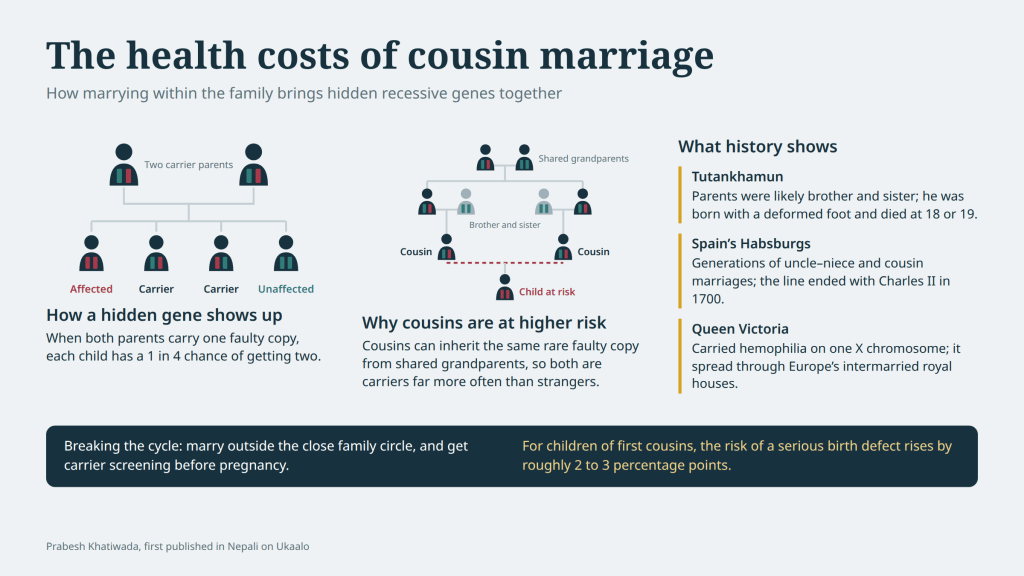
Inside the tomb were not only his mummy but also many other offerings, all well preserved. Studying Tut’s body and the other objects found in the tomb provided, for the first time, solid evidence that during Egypt’s New Kingdom the royal family married within the family (inbreeding) to preserve the purity of its ‘divine lineage.’ Examining Tut’s body revealed that his parents were full brother and sister. Tut, who died young, had been born with weak feet; his bones were abnormal, and he had other physical weaknesses as well.
Tut is evidence that the rulers of Egypt’s New Kingdom married within their own family for a long time. This practice, carried on for generations to preserve the ‘divine purity’ of the royal line, has been found to have left many physical disorders in the bodies of other pharaohs as well. Tut, it turns out, died young because of genetic disorders caused by long-running inbreeding. His tomb also held the mummies of his sister-wife and of two daughters who died in the womb. All three had congenital disorders like Tut’s, and many others besides.
The ancient Egyptian tradition of preserving the ‘divine lineage’ also reached later royal courts. Nearly four thousand years ago, Egypt’s pharaohs knew nothing of genetics. Like Tut, many other New Kingdom pharaohs also died young because of genetic diseases. Genetic diseases also played an important role in the fall of ancient Egypt. The Greek (Ptolemaic) rulers who came to govern Egypt after Alexander conquered it continued this pharaonic tradition. Cleopatra is the Ptolemaic dynasty’s famous queen. The Roman emperor Julius Caesar made both Egypt and Cleopatra his own. Before marrying Cleopatra, Caesar defeated her own brother-husband in war.
For some royal families, the purity of the lineage mattered more than anything else, and this practice and belief endured for a very long time. The custom of Egypt’s royal house continued into Greek and Roman civilization as well. Much later, it appears widely among Europe’s royal families too.
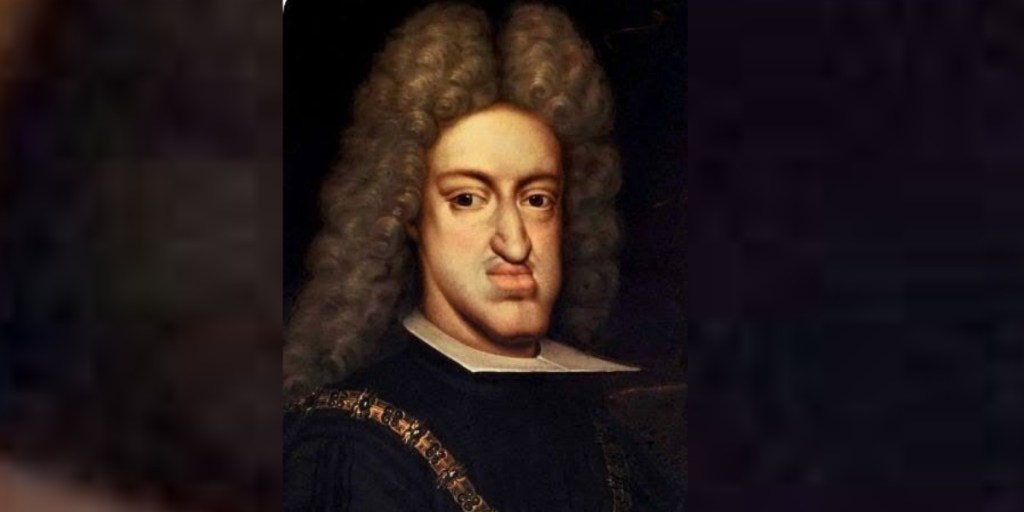
The Habsburg family, which once ruled Spain, long maintained the practice of marrying within the family to preserve the royal family’s ‘divine purity.’ The effects of their inbreeding appeared in all their descendants-a deformed jaw, also known as the ‘Habsburg jaw.’ Their rule perished with Charles III, who died of a genetic disease caused by inbreeding.
It was not only in Europe. Japan’s imperial family, too, once had a custom of marrying only within four families of the capital. Only after the Second World War did they realize that this practice, which lasted nearly eight hundred years, had left members of the imperial family, on average, shorter than other Japanese. Only then did they begin encouraging imperial family members to marry outside those families wherever possible.
The custom begun to protect the ‘purity’ of royal lineages was not confined to palaces. Community norms we still see-that one may marry only within the same religion, caste or community, or only if the combination of gotra, varna and nakshatra matches-are its remnants. Endogamy, the practice of marrying only within one’s own caste, religion or community, gradually took deep root in society. Unscientific traditions like this, begun to protect social identity and family purity, played the most important role in eroding people’s ability to fight disease.
Marriage Among Relatives and the Risk of Hereditary Disease
The secret of the genetic diseases passed down the generations lies hidden in our DNA. Almost all of us have the same twenty-three pairs of chromosomes. Within these chromosomes, DNA contains nearly 35 million nucleotides and nearly thirty thousand protein-coding genes. Which genes work, and the proteins they make, determine every kind of cell in the body, the types of organs, and the body’s many processes. Not every gene works all the time, though; in any cell of the body, only about ten thousand genes are at work at any one moment.
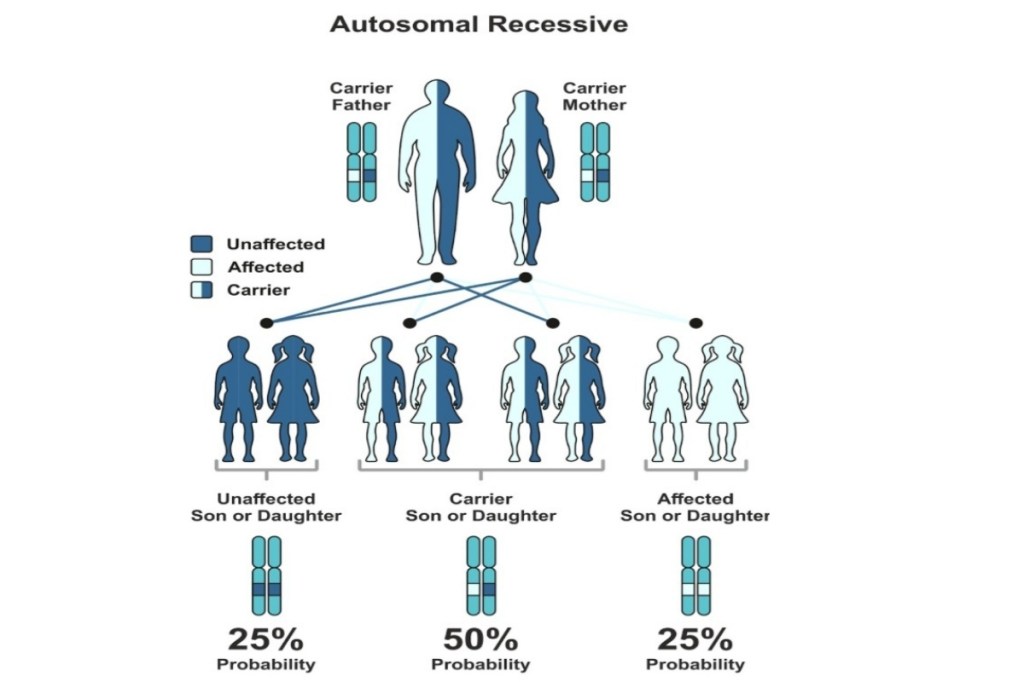
Each gene comes in two copies, called alleles: one from the mother and the other from the father. Which allele gets to work, and when, plays an important role in what the gene does. The two alleles rarely work at the same time, and they cannot both work with equal strength. This property is why alleles come in two types-effective (dominant) and ineffective (recessive). Most of the time, dominant alleles keep the recessive alleles of genes that could harm the body in check.
Most hereditary diseases-like Tut’s deformed body and those of Europe’s Habsburgs-appear when these recessive alleles become active. How these harmful recessive alleles come into play depends on how they are passed down through generations.
Children born to parents from unrelated families have a low chance of inheriting such a recessive disease. The custom of marrying the children of one’s paternal and maternal uncles (consanguineous marriage) still exists in some Muslim-majority countries and in some of our own communities. Marriage between close relatives, or marriage limited to a particular community, causes recessive alleles to surface and increases the likelihood of other diseases. If the children of one’s maternal uncle, paternal aunt, paternal uncle, or maternal aunt marry, the chance of recessive genes surfacing in their children rises by about twenty percent.
Hemophilia in Europe’s Royal Courts
One example of a disease that appears because of marriage among close relatives is the ‘royal disease,’ hemophilia. First appearing in Britain’s Queen Victoria, this disease spread to all of Europe’s royal families after her. Hemophilia is caused by mutations in genes on the X chromosome that produce the proteins needed for blood clotting. Because this recessive mutation affects only one allele on the X chromosome, it does not show in women, who have two X chromosomes. Queen Victoria carried this allele, but its effect did not show in her.
In Victoria, the recessive allele carrying the hemophilia mutation was kept in check by the dominant, non-mutated allele of the same gene. The recessive mutation she carried was passed down to her descendants. Each of her sons had a 50 percent chance of having hemophilia, and each of her daughters had a 50 percent chance of being a carrier like Victoria. Hemophilia took Victoria’s son Leopold young. Her daughters married princes across Europe, which is how this royal disease reached so many of Europe’s royal courts. Many other genetic diseases-cystic fibrosis, thalassemia, and others-are passed down the generations in the same way as hemophilia.
High Disease Rates in Communities That Practice Cousin Marriage
In children born to first-cousin marriages, harmful recessive alleles and the mutations they carry surface in exactly this way, and it is their effect that causes most hereditary and genetic diseases. X and Y chromosomes are passed down a little differently from the others, but in short, for these recessive diseases to appear, both parents must carry the disease-causing alleles. Marrying a close relative further increases the chance that both carry those alleles. In consanguineous marriages, the chance of genetic disease rises by 1.7 to 2.8 times.
For these recessive diseases to appear, both parents must carry the disease-causing alleles.
This custom still exists in some countries where Islam is practiced, and many of these countries show high rates of diabetes. Diabetes comes in two types, and their causes differ. One type, type 2 diabetes, is caused by defects in the genes that make insulin. The traditional custom of consanguineous marriage raises the chance that defects in the genes needed to make insulin are present in both alleles. In communities that practice consanguineous marriage, many of these recessive alleles carry mutations in pairs, and the resulting defects can cause insulin resistance and disrupt the balance of glucose metabolism, leading to type 2 diabetes.
The Lesson of History
Practices like these, carried out in various guises to preserve the purity of communities and lineages, gradually eroded the human species’ ability to fight many diseases. This custom of endogamy, which continues even today, shrank communities’ effective population size, narrowed our gene pool, and allowed harmful hereditary mutations to accumulate.
Some communities, however, have social rules that discourage marriage between close relatives. The Hindu-Sanatani rule in Nepal against marrying within the same gotra is one example. (Even so, while keeping apart by surname and gotra is the right thing to do, marrying only within the same caste or community is still tied to ‘blood purity.’) Sharing a gotra means having common ancestors who later split into different surnames. In most north Indian communities-Brahmin, Kayastha, Baniya, Vaishya, Rajput, and others-marriage within the same gotra is also ‘forbidden,’ although further south, marriage within the same gotra is accepted in some places. But we must also understand this: you might fool God by having a pandit recite mantras, but DNA does not recognize those mantras.
You might fool God by having a pandit recite mantras, but DNA doesn’t recognize them.
Pakistan’s high rate of type 2 diabetes is also due to consanguineous marriage. In our own country, too, the communities practice marrying the children of a maternal uncle, paternal aunt, paternal uncle, or maternal aunt. In those communities, high rates of diabetes, like those seen in Pakistan, along with other genetic diseases, have also been observed. The custom still exists in some Muslim countries. As genetic knowledge grows, the practice is declining. Thanks to education and awareness, DNA testing before marriage-even when a consanguineous marriage cannot be avoided-has also become more common to prevent genetic diseases that can arise when recessive alleles are expressed.
Mismatches in the balance between dominant and recessive genes do not occur only among relatives; anyone can face the risk of such genetic diseases when their recessive alleles happen to match. Anyone who wants to have a child can now get tested to find out whether the child could have genetic diseases. What’s more, where future children are found to be at risk of such diseases, new methods, including CRISPR, have emerged that can remove those mutations from the allele.
In the name of tradition-whether for a throne, a caste, or a clan-the genetic diversity we have lost is the very foundation of our existence. Today we stand at a crossroads where ancient tradition meets modern science. Whether by widening our social circle to embrace those beyond our narrow community or by using modern genetic screening (DNA testing), we have the power to tear down these self-made walls. We must not blindly repeat the mistakes of the pharaohs or the Habsburgs; the walls of this genetic prison must come down.


Leave a Reply