

Once the virus has vanished from the body, or the PCR report has come back negative for COVID-19, why doesn’t the body signal that the war is over?
This article was first published in Nepali on Ukaalo on December 26, 2025 (Poush 11, 2082 BS). This is the author’s own English translation. Read the original: https://www.ukaalo.com/news/31372/
There have been studies on what the coronavirus (COVID-19) is and how it spreads, but much remains to be studied about the changes the body undergoes after a COVID-19 infection and about how long COVID develops. In this context, a paper published by Rutgers Medical College has raised a question and a suspicion: could the long-term effects seen after COVID-19 be caused not by COVID-19 alone, but by our own body’s hidden enemies that rise up during the infection?
COVID-19 and Its Link to SARS
Beginning in the Chinese city of Wuhan toward the end of 2019, the COVID-19 infection spread within a few months into a worldwide pandemic. First identified five years ago, COVID-19 has affected most of the world’s people directly or indirectly. COVID-19 was given the name ‘SARS-CoV-2.’ It is a respiratory virus, meaning it affects the respiratory system.
The virus that causes COVID-19 is called SARS-CoV-2 because of the SARS epidemic in China in 2002–03. COVID-19 and SARS are both respiratory diseases, and their effects are similar. SARS-CoV-2, the virus behind COVID-19, is structurally and genetically similar to SARS-CoV-1, the virus that causes SARS.
Unlike SARS-CoV-2, SARS-CoV-1 did not attach easily to human cells. Because researchers identified infections quickly, the epidemic did not spread worldwide. The SARS outbreak at that time was limited to about ten thousand infections, and nearly a thousand people died of it.
SARS-CoV-2 carries spike proteins on its outer surface that can easily attach to cells in our respiratory tract. Because of this ability, COVID-19 spreads more easily than SARS, and an infected person can quickly pass it on to others. That is why COVID-19 spread to every continent in such a short time.
Questions About COVID’s Long-Term Effects
In most people, a COVID infection lasts two to three weeks. Once COVID has healed, the body has cleared SARS-CoV-2. Even though our immune system has removed the virus, that doesn’t mean the infection’s effects are over. In some people, various problems continue for months afterward. These long-term effects of COVID-19 are what we call long COVID.
SARS-CoV-2, the virus that causes COVID-19, cannot hide in our bodies. If the virus itself is no longer present, how do its long-term effects persist? Scientists are investigating this very question. In this context, a study recently published by researchers at Rutgers University has raised an important question: could long COVID be caused by COVID-19 reactivating other infections that were already hiding in the body?
The Structure of SARS-CoV-2 and How It Enters the Body
For most of us, COVID-19 begins when SARS-CoV-2 infects cells in the respiratory system. The virus can enter the body through the nose, mouth, or eyes via tiny droplets (aerosols) released when an infected person coughs, sneezes, or speaks.
Once inside the body, the virus’s first target is the cells of the lungs and respiratory system, whose surfaces carry a protein called the ACE2 receptor. Normally, the ACE2 receptor helps cells with external signaling and biological regulation. But in COVID-19, SARS-CoV-2 uses this very ACE2 receptor as its main entry point into the cell.
SARS-CoV-2 is an RNA virus. Just as we keep our genetic information in the DNA of our chromosomes, some viruses store it in RNA. SARS-CoV-2 has no DNA and has no need for it. Its genome is positive-sense RNA at the virus’s core. Being positive sense means that once it enters a host cell, it can readily use the cell’s machinery to make viral proteins. At the start of infection, SARS-CoV-2 does not need to enter the host cell’s nucleus or make new DNA or extra RNA first.
The outside of SARS-CoV-2 is covered by a lipid viral envelope that protects the virus. Soap and water, alcohol, or hand sanitizer can kill the virus by disrupting this envelope. Inside the viral envelope, the membrane contains three types of protein: spike, membrane, and envelope proteins. Of these, the membrane and envelope proteins provide the virus’s structural protection. At the virus’s core is its RNA, wrapped and protected by the nucleocapsid protein.
The Spike Protein and the Start of Infection
Spike proteins are the most important part of SARS-CoV-2 infection. They are also why COVID-19 is called a coronavirus. They look like a crown (corona in Latin) on the virus’s outer surface and come in two types: spike-1 and spike-2. Spike-1 attaches to the host cell’s ACE2 receptor, while spike-2 helps fuse the virus and host cell membranes. Compared with SARS-CoV-1, the spike protein of SARS-CoV-2 binds to the host cell’s ACE2 receptor much more easily and strongly. This is why COVID-19 spread across the world much more easily and quickly than SARS.
Once the virus’s spike protein binds to the host cell’s ACE2 receptor, a cell protease called TMPRSS2 becomes active. Able to cut proteins like scissors, it snips part of the spike protein, triggering the virus’s entry and opening the way for the viral RNA to enter the host cell.
In some cases, when TMPRSS2 is scarce, or the virus has mutated, the viral RNA can also enter the host cell through a process called endocytosis. The virus and the ACE2 receptor together form a small, spherical structure called an endosome, and the virus can enter the cell through this process. Omicron, which emerged after SARS-CoV-2 was first identified in Wuhan, mutated and infected cells through this same route.
How the Virus Copies Itself
Once the positive-sense RNA of SARS-CoV-2 reaches the host cell’s cytoplasm, it acts directly as messenger RNA and begins producing proteins. Using the host cell’s ribosomes, the viral RNA first produces the virus’s non-structural proteins. There are sixteen of them in total, and at the start of infection they are the virus’s main weapons. The non-structural proteins quickly begin to disrupt the host cell’s biological processes and redirect them toward viral replication. Early in infection, they build special structures inside the host cell that suppress the body’s early immune defenses and help speed up viral replication.
SARS-CoV-2 replicates differently from many other viruses. Its RNA is copied in the host cell’s cytoplasm. This virus never enters the cell’s nucleus and has no way to integrate into our DNA. As soon as SARS-CoV-2 infects a cell, the newly made proteins first build special structures inside it, whose membranes shield the viral RNA and its replication from the body’s immune system.
As soon as SARS-CoV-2 enters the cytoplasm of a human cell, it begins multiplying at extraordinary speed. Replication starts when an enzyme called RNA-dependent RNA polymerase makes a reverse (antisense) copy of the RNA. Using this as a template, forward (positive sense) copies of RNA, like those found in new viruses, are then made. Some of these RNAs are used again to make proteins, while others become the genomes of new viruses.
As COVID infection and viral replication progress, host cells become virtual virus factories. Their normal functions are gradually suppressed. The infected cells’ energy, amino acids, and ribosomes are all devoted to making new viruses. These cells eventually die, but not before producing large numbers of new viruses. The newly made viral particles leave the infected cells and spread the infection to nearby cells.
The Body’s Defense: War and Damage
A COVID-19 infection puts our body in a double bind. When infection begins, the body’s innate immune system (the early defense system) can recognize the virus’s proteins and RNA and produce cytokines, including interferons, to fight the virus. If the immune system recognizes the virus early and clears it quickly, a person has a chance of surviving a serious infection. The vaccines we receive are also intended for this purpose. But SARS-CoV-2 can suppress the body’s early defense system.
Once it begins infecting respiratory cells, the virus can produce many copies at once. COVID’s serious effects begin to appear when these newly made copies start attacking nearby cells. The infection becomes more complex, and the body’s adaptive immune system activates and joins the fight against the virus.
As the adaptive immune system begins fighting COVID in this way, serious effects start to appear in some people. In some, cytokine imbalance, blood vessel damage, and blood clotting set in, which can lead to acute respiratory syndrome, organ failure, and other serious effects. One way to understand it: becoming critically ill with COVID is the combined result of the COVID-19 virus and of the immune system fighting it.
Becoming critically ill with COVID is the combined result of the COVID-19 virus and of the immune system fighting it.
If our adaptive immune system does its job, COVID’s viral load gradually declines. After a COVID infection ends, remnants of SARS-CoV-2 do not persist in the body for long, and the virus cannot hide in the body’s cells or DNA. In almost everyone who has been infected and recovered, the virus’s RNA is gone from the body 14 to 21 days after infection.
This is the central question that puzzles science: once the virus has vanished from the body, or the PCR test comes back negative for COVID-19, why doesn’t the body signal that the war is over?
Long COVID: Why Do Problems Persist After Recovery?
SARS-CoV-2 has unique abilities that may cause many types of changes in the body. Problems that can appear later, even after COVID is over, because of changes that occurred during active infection are called long COVID, or in medical language, post-acute sequelae of SARS-CoV-2.
The symptoms of long COVID are unusual and vary from person to person. Some feel extreme fatigue, while others experience brain fog: a clouded mind, loss of concentration, and difficulty thinking. After active SARS-CoV-2 infection ends, fragments of viral RNA have been found lingering in some cells outside the respiratory system (for example, in the gut, brain, or other tissues). These fragments can hide in small amounts for some time and continue to cause inflammation. Likewise, fragments of dead virus may remain in the body, and our immune system may keep attacking them as if they were live virus. This is also one reason people continue to sweat or feel persistent fatigue long after COVID is over.
Some people have also developed myocarditis, a serious inflammation of the heart muscle. Severe COVID infection also affects blood vessels. Microclots form in the vessels, blocking oxygen from reaching various organs. This is why some people have trouble breathing and feel fatigued for a long time. Damage to lung or heart tissue during the fight takes a long time to heal, and in some cases the immune system may go astray and attack the body’s own healthy cells (an autoimmune response).
The Rutgers Study: The Theory of ‘Immunity Theft’
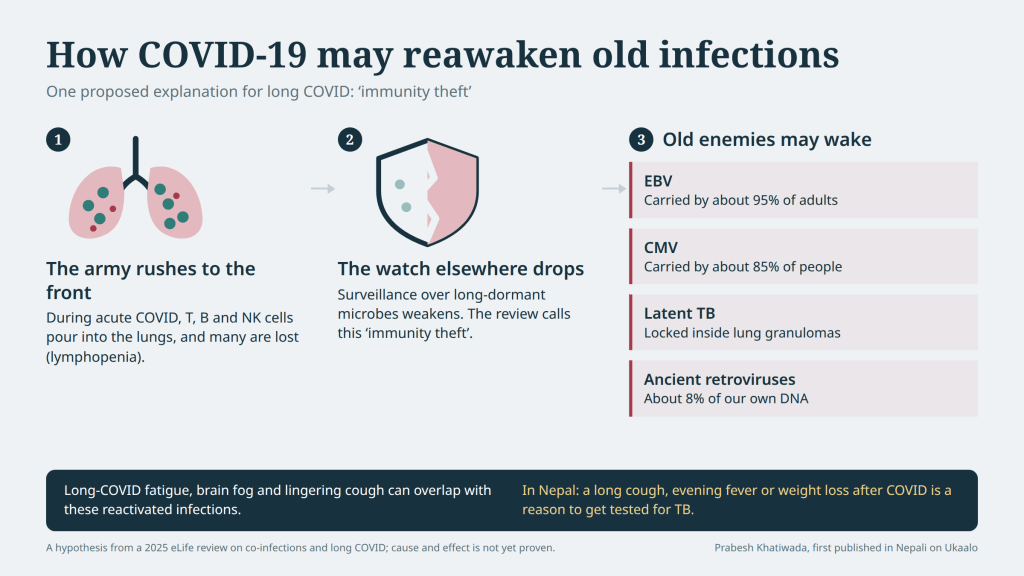
There is another possibility. When the body’s entire defense system is focused on fighting the coronavirus, it loses its watch over other dormant viruses and bacteria that it has kept suppressed inside the body for years. As a result, just as prisoners escape when the jail guards leave, old infections, the criminals, get a chance to rise up again. The study suggests that long COVID may be caused not only by remnants of the coronavirus but also by hidden enemies reawakened by the body’s weakened immune state.
A detailed review by researchers at Rutgers New Jersey Medical School has examined this possibility: could this unbalanced immune state be the very foundation of long COVID? They conclude that some of long COVID’s serious symptoms are not caused by SARS-CoV-2 itself. In their review paper, they point out that these permanent but dormant viruses, bacteria, and other ‘dark antigens’ may have been reactivated because of immune disruption (immune hijacking) during the fight against COVID infection.
Remnants of Old Diseases Hidden in Our DNA
If we turn the pages of our human genetic makeup (DNA) and read it as the biography of our chromosomes, we find that its earliest chapters were written by viruses. It may sound surprising, but a large part of our DNA is, in fact, a ‘viral remnant.’ Much of our DNA consists of the remains of ancient infections: fragments of prehistoric retroviruses, broken viral enzymes, and scattered genetic husks. Our DNA is not a clean page; it is a ‘historical manuscript’ in which viruses have written their stories. So it would be no exaggeration to say we are half human and a little bit ‘virus.’
Some viruses and bacteria have evolved the ability to hide within DNA itself. For example, retroviruses such as HIV, which can cause AIDS, can integrate their DNA into our chromosomes, where it can remain for life and be passed on to future generations. The remnants of ancient retroviruses that infected our bodies have made a permanent home in our DNA as transposons, or jumping genes.
Our DNA is not a clean page; it is a ‘historical manuscript’ in which viruses have written their stories.
Some bacteria or viruses can enter the cell’s nucleus and use its DNA-copying machinery but cannot integrate into the DNA. Some viruses associated with respiratory diseases have this ability. Some viruses (EBV, CMV) and some bacteria (TB), though unable to do either, suppress their own protein production to evade the immune system’s surveillance and have developed the ability to hide in various cells and persist in our bodies for life.
As I said at the start of this article, the virus that causes COVID-19 has no such ability, but its infection can trigger many changes in the body. First, even before serious infection sets in, the virus can remodel chromatin in the body’s immune cells. Put simply, the virus can change how the cell’s instruction manual is read or used. Such immune remodeling may leave long-term effects on the immune system. In a sense, COVID-19 is not only a respiratory disease but also an immune disease.
Chromatin remodeling can disrupt cytokine balance, creating long-term obstacles to the development of monocytes that recognize viruses and to the development of T and B cells that fight them. Even after the remnants of SARS-CoV-2 are gone from the body, transcriptional processes (how DNA becomes RNA and protein) that were altered during the infection remain distorted. Think of it this way: the immune system has already learned the wrong lesson and cannot unlearn it.
Immunity Theft: War at the Border, Insecurity in the City
Another long-term effect of COVID-19 is the very immune system that clears the infection. During a complex, acute COVID-19 infection, a biological state of emergency takes hold inside our bodies. As soon as SARS-CoV-2 attacks, the body’s entire defense machinery, especially T cells, B cells, and natural killer (NK) cells, drops other work and concentrates on the front lines in the lungs and respiratory system. After a COVID-19 infection, the body’s immune system is weakened: its soldiers have either been killed in battle or are utterly exhausted.
This is where the body’s security system slips up badly in the fight against SARS-CoV-2. In scientific terms, this is called immune distraction. Imagine the country’s entire army is busy at the border fighting a foreign enemy (the coronavirus). At such a time, internal security in the capital and other cities weakens, and hidden enemies within get a chance to rise up. The same happens in our bodies. This study has raised the question and the suspicion that the danger of long-term effects after COVID may come not from an outside enemy but from remnants of old viruses that have slept in our own bodies for thousands of years, waking up again.
The danger may come not from an outside enemy but from remnants of old viruses that have slept in our own bodies.
When the body’s immune system unites to fight COVID-19, the process by which it keeps constant watch over the body (immune surveillance) weakens. The Rutgers study calls this ‘immunity theft’ by COVID. The period of COVID infection thus becomes a major hole in the immune system, the security apparatus that keeps constant watch over the body. Hidden enemies take advantage of this very hole, which can give rise to latent tuberculosis, retroviruses, herpes viruses, or the Epstein-Barr virus. Lymphopenia, the shortage of white blood cells seen in COVID patients, widens this security vacuum even further.
About 8 percent of our DNA consists of remnants of ancient retroviruses that infected our ancestors millions of years ago and later became part of our genome. Normally, our body keeps them silent by placing an epigenetic lock on them.
But the immunity theft caused by COVID-19 can break those locks. As a result, these ancient viruses or transposons become active and start producing their own proteins. In this state, the body’s immune system treats even proteins made from its own DNA as foreign and begins to attack them. The study points to a strong possibility that some of the autoimmune problems seen in long COVID, in which the body attacks its own healthy organs, may be caused by these hidden enemies reawakening.
Hidden Enemies: Tuberculosis and Other Viruses
Retroviruses can integrate into our DNA and be passed down through the generations, but many other hidden enemies can also lie dormant in the body, waiting for a chance to become active again. Among these, the reactivation of Epstein-Barr virus (EBV) and cytomegalovirus (CMV) has made the symptoms of long COVID even more mysterious.
About 95 percent of adults worldwide have been infected with EBV. Likewise, CMV has infected 85 percent of the world’s people. Our immune system recognizes this childhood infection and clears it easily. Even so, small amounts of the virus may persist and remain hidden in the body for life. Normally, in almost everyone infected, our immune system’s surveillance keeps these small amounts of lingering virus in check.
When the body’s immune system digs in to fight COVID-19, immune surveillance weakens elsewhere in the body, and these old, opportunistic viruses lying dormant get a chance to rise up. As the Rutgers study shows, when COVID-19 erodes the function of the immune system’s soldiers—the T, B, and natural killer cells—EBV can be reawakened. This may be why the rate of patients arriving at hospitals with reactivated EBV has been rising by ten percent every year since the COVID pandemic.
The brain fog, extreme fatigue, and neurological weakness that long COVID patients experience closely resemble the symptoms of active EBV. Likewise, when CMV becomes active, it causes inflammation in blood vessels and accelerates the entire immune system’s aging (immune aging). This is why, even at 30 or 40, the body can begin to feel the fatigue and weakness of someone aged 60 or 70.
For a country like Nepal, however, the most worrying issue is the reactivation of latent tuberculosis, or latent TB. In a large part of our population, TB bacteria lie dormant within small nodules (granulomas) in the lungs. The excessive inflammation that COVID-19 brings risks breaking down the structure of these nodules that keep the bacteria confined. Just as prisoners escape when the jail walls crumble, these bacteria begin to spread through the lungs.
This is where the problem becomes even more complicated. The symptoms of active TB and long COVID (a persistent cough, evening fevers, weight loss, and extreme fatigue) are very similar. As a result, patients and doctors may mistake them for the ordinary after-effects of COVID, or simply long COVID. This study makes us seriously consider that if health problems persist for a long time after COVID, they may not be just the virus’s effect but tuberculosis that COVID has awakened. Therefore, when managing long COVID patients in Nepal, TB testing should be a mandatory priority.
For a country like Nepal, the most worrying issue is the reactivation of latent tuberculosis.
Another Danger: Immune Amnesia After COVID
Another far-reaching and frightening effect of COVID-19 infection is immune amnesia, or immune forgetting. Just as old files are lost when a computer is formatted, a severe COVID-19 infection can damage our immune system’s memory bank.
As mentioned in the Rutgers review, there are signs that COVID, like measles, can wipe out the body’s store of memory B cells and antibodies. This means that after COVID-19, our bodies may forget the vaccines we received in childhood or the diseases we fought and beat in the past. As a result, even after recovering from COVID, people remain at risk of easily falling prey to pneumonia, the flu, or other common infections.
In the end, we must understand that COVID-19 turns out to be more than just a viral infection. A COVID-19 infection can also trigger an imbalance in the body’s immune system and awaken enemies that have hidden in our genes and bodies since ancient times. In treating long COVID, which appears sometime after COVID, there now seems to be a need for diagnosis and treatment that accounts not only for the coronavirus but also for the old infections it has reawakened. COVID-19 has taught us a new lesson: the virus may be gone, but we still have much to prepare before we can fight the biological shadow it leaves behind.
(This article focuses on the question raised by this research published from Rutgers.)


Leave a Reply