


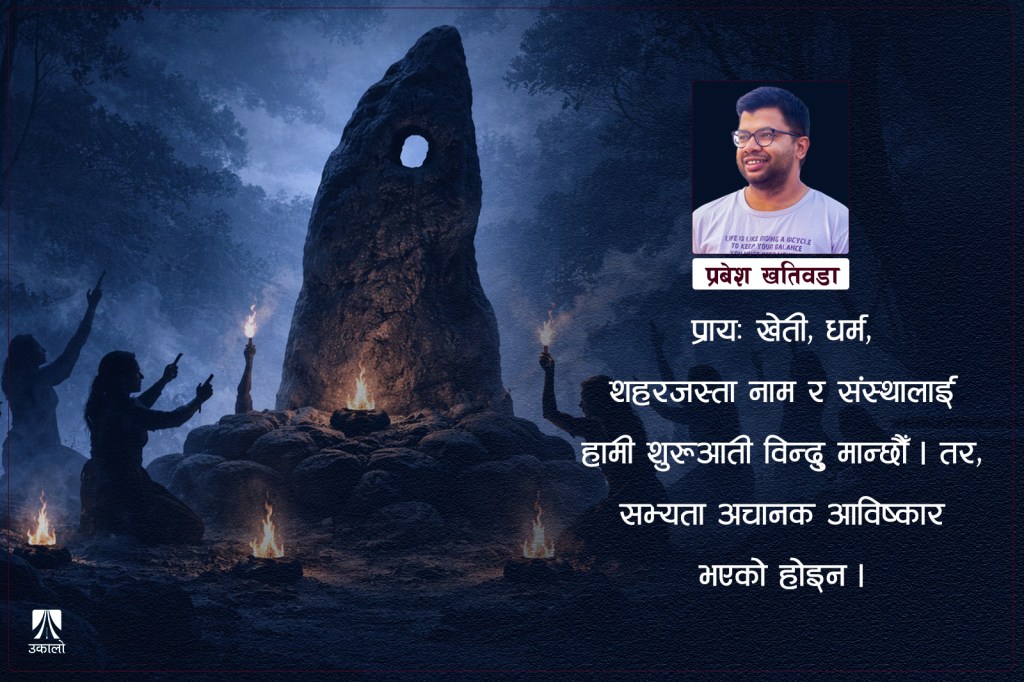
This awareness among women, that sowing seeds in the yard of one’s own hut and tending them was safer than roaming the forest, was in fact the starting point of agriculture.
This article was first published in Nepali on Ukaalo on February 5, 2026 (Magh 22, 2082 BS). This is the author’s own English translation. Read the original: https://www.ukaalo.com/news/32200/
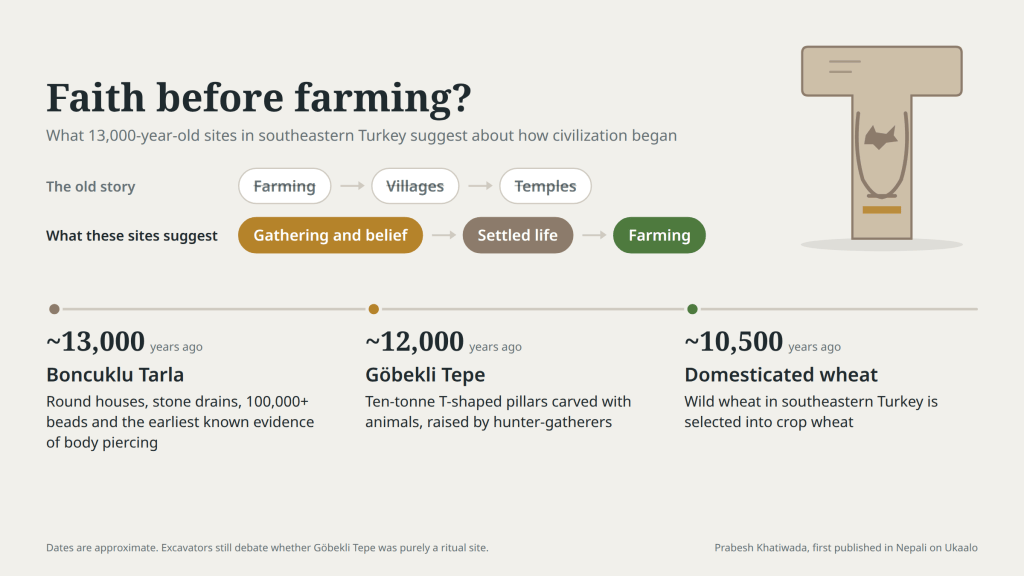
What Turkey’s ancient sites suggest about how civilization began, at a glance.
We were always taught that the belly was filled first, and only then did people remember the gods. But 13,000-year-old ruins in Turkey have turned this story on its head. Discoveries at Göbekli Tepe and Boncuklu Tarla have shown that what bound people to one place was not the plow but faith. Some dismiss this as a ‘popular interpretation.’ This is a journey through 13,000-year-old drains, decorative jewelry, and even ‘piercings’ to a time when the ‘egg of faith’ was born before the ‘chicken’ of civilization.
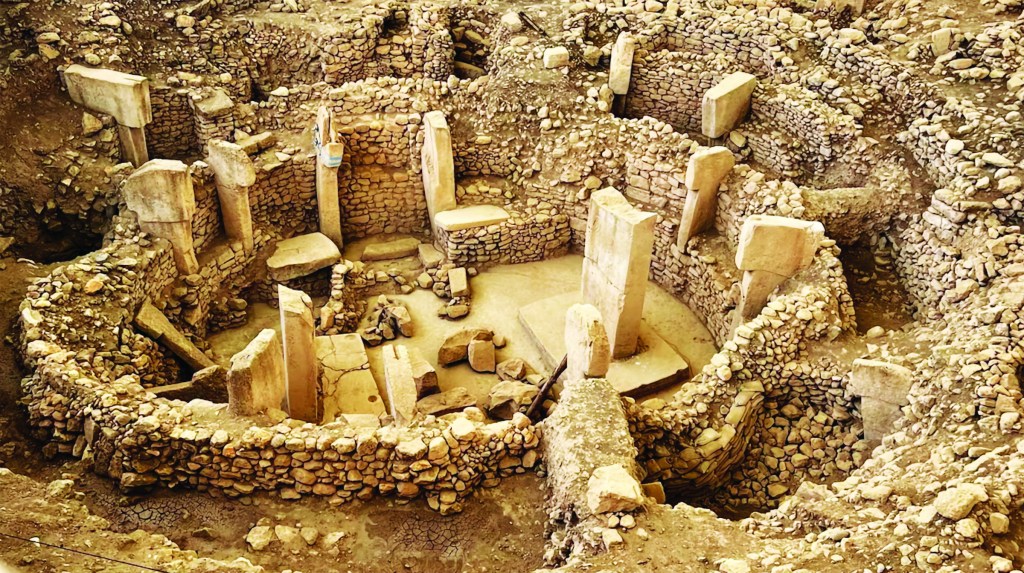
Göbekli Tepe.
The Chicken, the Egg and Our Confusion
Which came first, the chicken or the egg? Many of us know this question well. But in seeking a simple answer, we usually get it wrong. Many find the answer easy: the chicken, because without a chicken an eggshell cannot form. Many of us know that the protein needed to build the outer part of the egg (such as ovocleidin-17) is found only in the body of a hen. On this basis, the usual conclusion is that an egg cannot be made without a chicken, so the chicken must have come first.
This is where our confusion lies: the conclusion is easy but incomplete. We treat the question as if it were about an event that happened suddenly at a single moment, but the evolution of living things is the result of a process of change that unfolds continuously over a long time.
Biology makes a different argument: the egg is far older than the chicken. Some 80–90 million years ago, in the age of the dinosaurs, and even earlier, as reptiles were evolving, these animals had already developed the ability to lay eggs. Only after thousands of generations of evolution among these reptiles did the chicken’s close ancestors appear.
The chicken is not an animal that appeared suddenly one day. It is simply the outcome of an evolutionary process, built from changes that accumulated gradually over many generations, and we have named it the chicken. In biological evolution, no species is separated from another by a clear line. The changes are small; humans give them names later.
The Evolution of Language and Biological Continuity
Comparing this with the history of language makes it even clearer. Latin did not suddenly become Italian one day. The first people did not learn Italian from their parents. They spoke a form of Latin that had been changing gradually. Latin shifted slowly: its sounds changed, its grammar was revised, its words took new forms, and one day we began calling that language ‘Italian.’ The parents of the first Italian speaker were not Italian, but today we call their children Italian. The name was new, but it was the continuation of an old process.
The chicken’s story is the same. The biological mechanism for producing eggshells already existed. A small genetic mutation occurred inside an egg, between two ‘almost-chickens.’ The mother’s body was already ‘almost-chicken,’ and the egg was already an ‘almost-chicken egg.’ The shell and the method were old, but the embryo inside crossed that small biological boundary, which, looking back later, we came to call ‘chicken.’ In this sense, the egg is not just a biological structure; it is a vessel of continuity, where the new is born within the old.
The egg is not just a biological structure; it is a vessel of continuity, where the new is born inside the old.
The Debate Over Civilization: Farming First, or Religion?
Which came first, the chicken or the egg? The same logic applies to the debate over civilization. At the beginning of human civilization, did farming come first, or faith and religion? As with the chicken and the egg, this question has long troubled anthropologists. We often treat names and institutions such as farming, religion, and cities as starting points. But civilization was not an invention that appeared suddenly in a single moment. Like the story of the chicken and the egg, civilization too began through a gradual process, slowly taking shape within old practices, beliefs, and ways of life.
Traditional maps of human history long placed the origin of civilization in the fertile region around Turkey’s Taurus Mountains and the Tigris and Euphrates rivers. The earliest human settlements were believed to have emerged in this region, known as the ‘Fertile Crescent,’ which curves like a half-moon across parts of today’s Turkey, Syria, Iraq, and Iran. But recent excavations have pushed this story north of the Taurus Mountains, toward southern Anatolia in present-day Turkey.
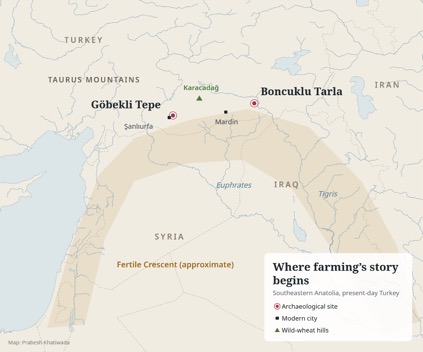
Göbekli Tepe, Boncuklu Tarla and Karacadağ in southeastern Anatolia. The Fertile Crescent boundary is approximate.
About 13,000 years ago, people in the hills of southeastern Anatolia were not merely wandering hunters. They are now known as ‘complex foragers.’ They hunted, gathered wild grain, and moved with the seasons, yet returned again and again to the same area. It is in this very region, north of the Fertile Crescent, that we find the oldest evidence of farming, dating to about 13,000 years ago (11,000 BCE).
The Invention of Farming and the Role of Women’s Insight
About 12,000 years ago, the world was recovering from the Ice Age and beginning the ‘Holocene’ epoch. As the Ice Age ended, the Earth’s temperature began to rise, and as the ice melted, most of the land in the Northern Hemisphere became arable for the first time. Around this time, people who were caught between hunting and gathering, especially women, noticed something new: where wild seeds had fallen and been collected, new plants sprouted the following year again.
General historical knowledge tells us that farming did not begin all at once. This greatest change in human history did not start in a laboratory or through a sudden event. It resulted from thousands of years of careful observation and patience, and the credit goes mainly to women. While men traveled far to hunt, women gathered roots and wild grains around the settlement and began to observe the life cycle of plants up close. They were the first to understand that plants sprout and thrive best where fallen seeds mix with organic waste (manure).
This awareness among women that sowing seeds in the yard of one’s own hut and tending them was safer than roaming the forest was, in fact, the starting point of agriculture. Over thousands of years, women in hunter-gatherer groups selected the ‘good, non-shattering’ seeds of wild wheat, transforming it into domestic wheat and launching the age of farming. The discovery at the foot of Turkey’s Karacadağ mountains of DNA remains of the world’s oldest wheat, dating to nearly 13,000 years ago, also bears this out.
In this way, a small experiment that began with kitchen waste being thrown out eventually turned humans from ‘wanderers’ into ‘farmers.’ When people understood the relationship between seed and manure, humanity’s daring to take control of nature’s cycle began. Yet even the idea that civilization’s chicken hatched from this egg is incomplete.
Göbekli Tepe: When Faith Led the Plow
For a long time, historians believed one story: first people learned to farm, then they built permanent houses. Only when their granaries were full and they had leisure could they build temples and practice religion. In other words, ‘first the belly was filled, and only then were the gods remembered.’
But after the German archaeologist Klaus Schmidt began excavating at Göbekli Tepe in southeastern Turkey in 1994, this account of our development was shaken to its roots. This roughly 12,000-year-old structure was not only the world’s first temple but also the first ‘3-D’ expression of human consciousness.
The giant T-shaped limestone pillars standing in circles, each weighing nearly ten tonnes, were not just shapeless stones; they were also faceless, human-like gods. The carved arms and meditative posture indicate that people of that time could already worship nature through symbols. Scorpions, foxes, and lions are carved on the pillars as if about to leap out of the stone, showing that people then did not merely fear nature but could understand and worship it in symbolic form.
Building the massive structures at Göbekli Tepe required hundreds, even thousands, of people. Who brought those hunters together, and why did they come? Göbekli Tepe unlocked one of history’s great mysteries: people first gathered in one place for religious or spiritual rituals, and that very gathering created the need for farming.
When Göbekli Tepe was built, people had not yet fully mastered farming. Excavations nearby have uncovered no permanent homes or farming tools. Yet thousands of people needed food while staying there for weeks to build the temple and hold festivals, and wild foods alone could not feed them. The need to feed these crowds may have led people to gradually domesticate the first grains, wheat and barley. Göbekli Tepe revealed a new possibility: the desire to build temples may have led people to become farmers.
For a long time, we believed that the chicken of human civilization hatched from the egg of ‘farming.’ But the discovery of Göbekli Tepe revealed a different egg: the egg of faith. What turned wanderers into settled communities was not the plow but a shared belief in an unseen power. Göbekli Tepe was the temple of hunters who carved gods in stone long before they learned to sow wheat.
The desire to build temples is what made people farmers.
Boncuklu Tarla: The First Foundation of Civic Life
Göbekli Tepe pushed history back 11,500 years. But Boncuklu Tarla, a human settlement discovered in 2008 in Turkey’s Mardin province, pushed the starting point of civilization even further back. The site is considered nearly 1,000 years older than Göbekli Tepe, or about 13,000 years old. While Göbekli was mainly a ritual center or temple, Boncuklu Tarla had already become a full-time ‘human settlement.’
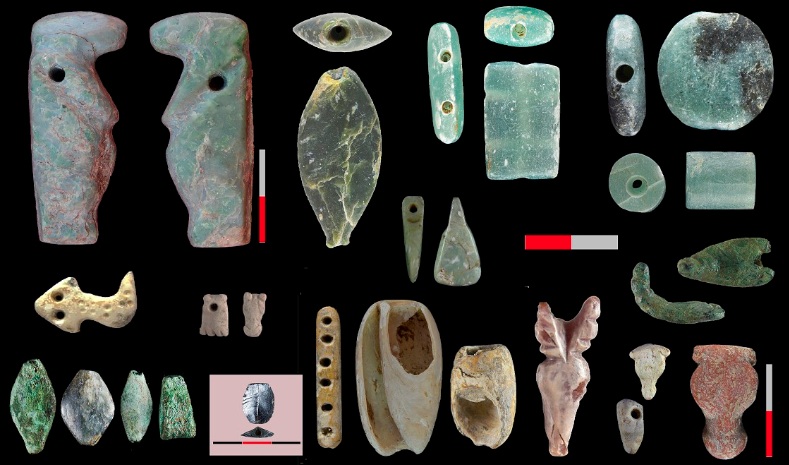
Jewelry found at Boncuklu Tarla.
Evidence of permanent settlement missing at Göbekli Tepe has been found at Boncuklu Tarla. Its inhabitants had already begun building round houses, marking an early shift from ‘wandering’ to ‘settled’ life. They had also begun crafting early prototypes of the T-shaped pillars seen at Göbekli Tepe, showing that Göbekli Tepe’s grand structures were not built overnight but were the product of centuries of human labor.
Boncuklu Tarla has more than orderly housing. Most astonishing of all, researchers found an organized ‘drainage system’ there. That people built stone channels to keep their settlement clean some 13,000 years ago was no ordinary feat. It shows that those hill-dwelling hunter-gatherers had begun laying the groundwork for community health and permanent settlement long before they fully knew how to farm.
That people built stone channels to keep their settlement clean some 13,000 years ago was no ordinary thing.
The Origin of Identity and Ritual
We often think of early humans as mere creatures struggling to survive, but the people of Boncuklu Tarla were keenly aware of their ‘self’ and identity. Boncuklu Tarla literally means ‘field of beads.’ True to its name, more than a hundred thousand ornaments made of limestone, obsidian, and bone have been found at the site, which covers about thirty acres.
More interesting still, research published in 2024 shows that people there practiced ‘piercing,’ the ritual of piercing the body. When people began living in communities, they needed not only food and water but also identity and stability. Stone ornaments found near the ears and lower jaws of skeletons here provided the first evidence of body modification. These were not merely art: thousands of years before the first kings of Uruk wore crowns, people had already begun signaling their social status and individual identity.
Boncuklu Tarla proved that people of that time had not only an ‘ideal’ of worshipping gods but also developed a ‘principle’ of living together cleanly and in an orderly way. We did not settle in one place because we had plenty of food; rather, we gave up the wandering life in search of a new ‘ideal’ for human life. We wanted to be near those beads, to stay in the lap of our ancestors buried beneath the floors of our homes, and to live within the safety of an orderly environment.
The excavation of Boncuklu Tarla has revealed a new reality: building drains, stringing jewelry, and planning settlements were not pastimes taken up once the granaries were full. They were part of a search for a new ‘ideal’ of what human life should be, a search that began long before farming. If the search for an ‘ideal’ drew early humans to Göbekli Tepe, the egg of ‘principle’ had already formed at Boncuklu Tarla long before.
We did not settle in one place because we had plenty of food; we gave up the wandering life in search of a new ‘ideal’ of what human life should be.
Conclusion: The Continuous Transformation of Civilization
If we accept Göbekli Tepe as the ‘zero point’ of religion, Boncuklu Tarla can be considered the ‘zero point’ of civic life. The ‘zero point’ of human civilization was not a sudden explosion as we imagined. It is the result of a long, complex process in which our consciousness expanded, beginning at Boncuklu Tarla and branching out at Göbekli Tepe. Just as Italian needed hundreds of generations of ‘linguistic change’ to emerge from Latin, thousands of years of development, the beads of Boncuklu Tarla, the stone gods of Göbekli Tepe, and the grains of wheat that women preserved together prepared civilization’s common stage.
That is why agriculture, faith, and consciousness are bound together at the starting point of human civilization. In this sense, the ‘chicken’ (civilization) we have been looking for was not born from any single egg. It is the result of an endless bargain among many eggs: hunger and faith, personal identity and collective responsibility. The jewelry we wear today offers a glimpse of those 13,000-year-old ‘beads,’ and the engineering of modern cities bears the footprint of that first drain.
The real answer to the question asked at the start, ‘Which came first, the chicken or the egg?’, is perhaps this: ‘change’ comes first. The names (farming, religion, city) came later, but the human restlessness and dreams needed to create them already existed. This is how civilization’s chicken was born, in whose yard we stand today. We too remain a link in that same change, a journey that began in those hills of Anatolia and continues.


Leave a Reply