


A lobster that has grown for 100 years and one that has just turned 10 have telomeres of the same length on their chromosomes. Shortening telomeres are the primary clock driving us toward old age; in the lobster, that clock simply doesn’t exist.
This article was first published in Nepali on Onlinekhabar in August 2026 (Bhadau 2, 2083 BS). This is the author’s own English translation. Read the original: https://www.onlinekhabar.com/2026/08/1998447/lobsters-dont-age-they-die-of-exhaustion-multicellular-organisms-deal-with-death
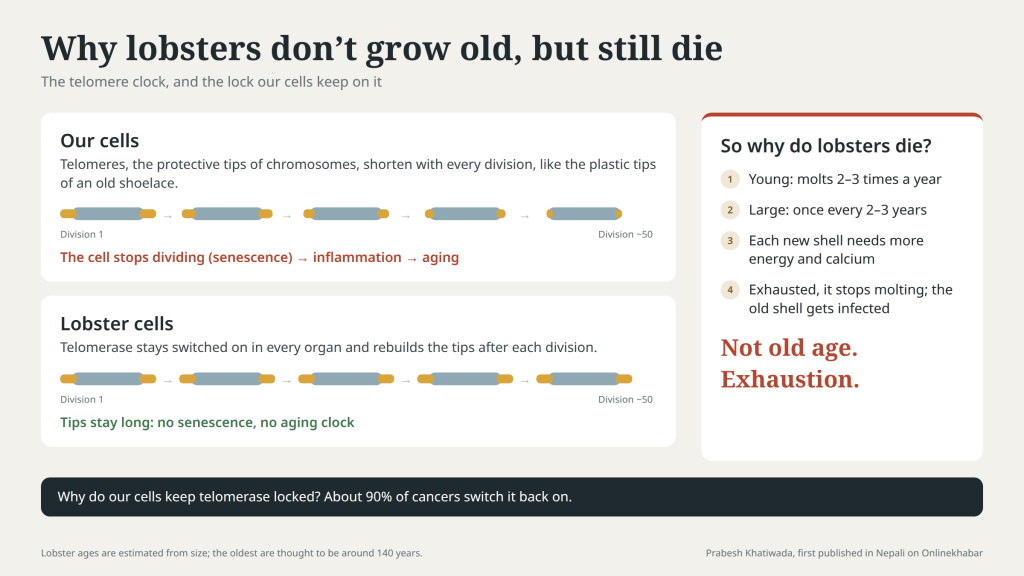
Why lobsters don’t grow old, but still die, at a glance.
The empty crab shell you find on the ridge of a rice field is merely the old shell a crab outgrew and left behind; the crab itself hasn’t died. The lobster, the crab’s sea-dwelling relative with the same shell-shedding habit, never grows old. The enzyme telomerase renders a lobster’s cells immortal, but our own bodies keep that very enzyme under lock and key.
The Empty Crab Shell on the Field’s Edge
My school summer holidays were spent playing in the mud of monsoon rice fields. I was always afraid of running into a crab out there. They built their homes in the ridges between the fields, and the water leaking through their holes drove everyone mad. Sometimes, on those ridges, I would find a crab-shaped shell: two pincers (claws), eight legs, even the little sockets for the eyes, all exactly in place, but completely empty inside. Even finding one thrilled me that a crab had died.
Only long after I left school did I learn that the “dead crab” I had found was just the old shell a crab had outgrown and abandoned. A crab has no bones; its outer shell is its skeleton. As a crab grows, its body gets bigger, but its shell stays the same size. Once its body has grown, the crab splits the old shell open from behind and climbs out, building a new shell again and again throughout its life.
The crab that left its shell on that ridge in Jhapa had simply shed its old shell, and the crab itself was hiding in a burrow a little way off, waiting for its new shell to harden.
The crab has many relatives that share the habit of shedding their shells. Its giant cousin lives in the sea: the lobster. The design is the same: an outer shell, ten legs, and two large claws in front. The only differences are that the lobster lives in salt water, grows much larger, and lives far longer than a crab.
Four Hundred Years Ago, Lobsters Were Gathered by the Bucket
Four hundred years ago, lobsters were everywhere around New England (Boston) in North America. According to European settlers’ accounts, every morning the waves left “piles of lobsters two feet high” on the shore. You could take a bucket and gather as many as you liked. But not to eat or sell: farmers used lobsters to fertilize their fields.
Found everywhere in the sea, the lobster was called the cockroach of the sea. The name wasn’t given for nothing; it was food for the poor, servants, and prisoners. In the eighteenth century, prisoners in America are even said to have protested against lobster being served more than three times a week. It sounds astonishing today, but back then nobody liked lobster.
Today, a plate of lobster costs nearly 100 dollars, and we consider it a luxury. In the very New England waters where lobsters teemed three or four hundred years ago, they are now disappearing. Overfishing is one reason, of course, but the warming sea is shrinking their numbers every year.
In warm water, their shells are more susceptible to disease, and the young struggle to grow. As a result, New England’s lobsters are slowly being pushed north in search of colder water.
The Creature That Never Grows Old
So far, the lobster’s story sounds as ordinary as any other creature’s: the sea warmed, so they moved north in search of colder water.
Lobster numbers in the sea fall every year. But here is the most astonishing part: almost all creatures grow old and die of old age. This is exactly where the lobster is different: if nature has made any creature immortal, it is the lobster.
The secret of the lobster’s immortality lies in telomerase. Our bodies have telomerase too, but they keep it locked away.
The crabs I found on those ridges grow old and die; their life cycle is limited. But a lobster never grows old; it shows no signs of aging. If you pulled a hundred-year-old lobster and a ten-year-old lobster out of the sea and examined them, you would find no real difference at the genetic level. Its body grows bigger with age, but its muscles stay just as strong. Its ability to lay eggs does not decline with age; instead, it increases as the body grows larger. And it is not only the muscles: the ability of its cells to divide remains the same in lobsters of every age.
In other words, whatever cells, muscle, and physical capacity a young lobster has, it retains them a hundred years later. For us humans, after age thirty, the chance of dying from biological causes doubles every eight years; for a lobster, that chance stays the same no matter how old it gets. If lobsters could keep shedding their shells, they could live forever. But even though their cells never age, once their bodies have grown very large, lobsters stop making new shells.
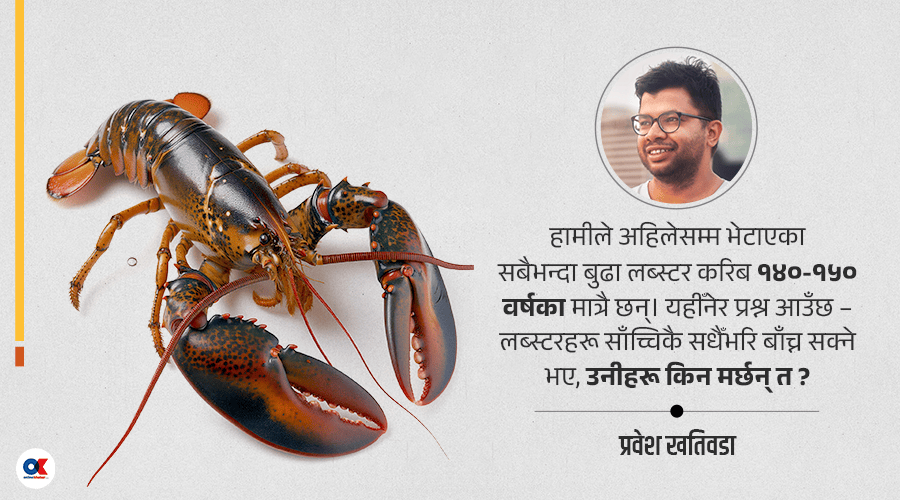
The oldest lobsters we have found so far are only about 140–150 years old. This raises the question: if lobsters can truly live forever, why do they die?
To Be Multicellular Is to Accept Death
To find the answer, we have to set the lobster aside for a moment and go far back in time, to when there was only single-celled life on Earth.
There is a bacterium in pond water. It has enough food, and the temperature is right. It stretches its body, copies its DNA, and splits down the middle into two. There is no way to tell which is the mother and which the offspring; both are the same, both are new. Bacteria die of hunger, heat, poison, or being killed by other creatures. But a bacterium never dies of old age; aging simply does not exist in its life.
For roughly the first three billion years, life on Earth carried on just like this: there was death, but no aging. Only about a billion years ago did single-celled organisms begin to become multicellular. Instead of separating after cell division, some cells began to stick together and divide the work: some became the outer layer, some digested food, and some provided movement.
A single-celled organism, given the right conditions, can keep dividing and live forever. But when trillions of cells come together to form a heart, a brain, and a body, they must be disciplined: divide only when needed, repair their own damage, and if they can’t repair it, remove themselves for the good of the body.
So cells stopped seeking the kind of immortality bacteria have and began to share the work instead. The job of carrying on the lineage was taken by a select few cells, called ‘germ cells’ (reproductive cells). The body’s immune system needs new cells, and there is a small reserve to supply them: ‘stem cells.’ All the rest, in the heart, the skin, the liver, became the ‘somatic cells’ (ordinary body cells) that keep the body running. As we age, every somatic cell’s ability to copy itself declines. The struggle to replace the body’s worn-out cells grows with age, and that is what we call aging.
Where Is a Cell’s Age Written?
We have all seen the small plastic tips on both ends of a shoelace. Those little plastic tips do nothing for the lace itself; they don’t make it stronger or longer. They are there to stop the lace from fraying at its ends, and they wear away the older the shoe gets. Just by looking at those plastic tips, anyone can easily guess how many times the shoe has been worn.
Like a shoelace, each chromosome has a record at both ends of how many times a cell can divide or has already divided. At each end of every chromosome, there is a repeating sequence of nucleotides, TTAGGG, TTAGGG (in lobsters, TTAGG, TTAGG), repeated thousands of times. This structure, called the telomere, makes no protein and carries no trait for the body. It works like the plastic tip of a shoelace, protecting the useful DNA inside from fraying.
Every time a cell divides, a new copy of each chromosome must be made. Copying chromosomes is the job of an enzyme called DNA polymerase, and this is where the trouble begins. DNA polymerase cannot reach the very tip of the chromosome and copy it exactly. As a result, every time a cell divides, the telomere loses a few dozen nucleotides.
Just as the plastic on a shoelace wears away a little each time you put the shoe on, each new cell division shortens the telomere. At first, this does no harm. But there is a limit to how short it can get before it matters. In humans, somatic cells divide about 50 times on average. After that, the shortened telomere can no longer protect the chromosome’s structure. Scientists call this limit, beyond which the telomere is too short to keep the chromosome intact, the Hayflick limit.
Once the telomere passes this limit, the chromosome’s structure begins to break down. Inside the cell, a kind of guard patrols: the ATM and ATR kinases. They recognize chromosomes with shortened telomeres as broken DNA. Their message reaches p53, the strongest guard keeping watch inside the cell. Once alerted, p53 orders the cell to stop dividing. Cells that can no longer divide are called ‘senescent cells’ (worn-out cells).
Senescent cells do not die, but they also cannot divide again. Though they can no longer be replaced by new cells, they do not sit quietly. They continue to leak molecules that drive ‘inflammation’ (swelling) and enzymes that break down the surrounding tissue.
Until we are about 20–25 years old, senescent cells make little difference to the body. In fact, they alert the immune system so that wounds heal quickly. But as we age, the immune system can no longer clear them away properly everywhere. Their numbers pile up, and the body lives with constant inflammation. This is what we understand as a body gripped by aging.
Like the plastic tip of a shoelace, the telomere at the end of each chromosome gets shorter with every cell division.
The Secret of the Lobster That Never Ages: The Telomerase Enzyme
Lobster cells have an enzyme that is always at work: telomerase. Every time a cell divides, it keeps the telomeres at the ends of the chromosomes from getting shorter. Its job is to add back the telomere letters lost in each division. In a lobster’s somatic cells, telomerase is always active. However, even when the body’s cells are replaced many times, the tips of the chromosomes stay the same.
The secret of the lobster’s immortality lies in telomerase. Our bodies have telomerase too, just like the lobster’s. But the body keeps it locked away. In all our somatic cells, except germ cells, stem cells, and some immune cells, the gene that produces telomerase is permanently switched off.
Lobsters still die, and the reason is not an aging body but their inability to make a new shell.
That is why, in the cells of our skin, liver, and muscles, once telomeres start to shorten, they can never grow long again, just as the plastic tip of a shoelace can never return to its original state once it starts to fray. In lobster cells, it is the opposite. Take cells from any organ, such as muscle, liver, nerve, or ovary, and telomerase is switched on.
The result is simple: no matter how many times the cells divide, the tips of the chromosomes remain unchanged. The telomeres never reach the Hayflick limit, the ATM and ATR kinases never receive a signal of DNA damage, p53 is never activated, and the cells never have to become senescent, or old.
A lobster that has grown for 100 years and one that has just turned 10 have telomeres of the same length on their chromosomes. Shortening telomeres are the primary clock driving us toward old age; in the lobster, that clock simply doesn’t exist.
Why Did Our Bodies Lock Telomerase Away?
So why is the telomerase that runs nonstop in lobsters switched off in us? Why not just unlock it? If our somatic cells could keep their telomeres long forever, it seems we would never age. Why didn’t nature make us like lobsters?
In fact, this very option is being tested inside our bodies every day. The name of that experiment is cancer.
Cancer is not an enemy from outside. It is our own somatic cells breaking the bargain struck a billion years ago and trying to return to the old, single-celled way of life. Ignoring signals from neighboring cells, disregarding warnings that DNA is damaged, and racing to make copies of themselves: all of this comes naturally to bacteria. But inside a body made of trillions of cells, the same behavior becomes deadly.
Even cells trying to become bacteria-like in this way cannot divide more than about fifty times; the same Hayflick limit stops them, too. That is why; to become cancerous, cells must first stop their telomeres from shortening. That is exactly what we find in about 90 percent of cancers: the lock on telomerase has been opened. First, mutations pile up, and by the time the cancer has formed, the chains holding back the TERT gene, which makes telomerase, have come loose, and the tumor spreads unchecked.
Like lobster cells, cancer is immortal too. In 1951, Henrietta Lacks was 31 when she arrived at a hospital in Baltimore with cervical cancer. During her treatment, a small piece of her tumor was taken and sent to the lab for cell culture. Henrietta died that same year, but her tumor did not. It kept dividing and dividing. The “HeLa cells” taken from her tumor are still alive in laboratories seventy years later.
So Why Didn’t the Lobster Become a Cancer Factory?
An obvious question may arise here: if telomerase is always active in lobsters, shouldn’t they be cancer factories? Yet it is fair to say that cancer has not been found in lobsters; so far, evidence of tumors in them is negligible.
We can guess at a few reasons. First, telomerase alone is not enough to cause cancer. Telomerase is only one key; for cancer to form, many other systems have to be disrupted one after another.
In our bodies, telomere length is just one wall among many. The lobster lacking that one wall does not mean all the other walls have fallen. Even though telomerase keeps working and the lobster’s telomeres never shorten, other safeguards that prevent cancer are still on duty.
Not aging is not the same as being immortal. For lobster or human, death is inevitable for every multicellular creature.
Second, a lobster’s body has few organs that, like ours, must divide every day. The cells of our gut, skin and blood have to be renewed daily. The more cells divide, the more chances there are for mutations. And cancer, too, usually starts in exactly such fast-dividing places.
By producing telomerase, lobsters switch off the clock that marks the body’s age. Their telomeres don’t shorten, and they don’t get cancer the way we do. Lobsters still die, but not because of an aging body. The reason is their ability to make a new shell.
And One Day, the Lobster Stops Molting
Just like a crab’s, a lobster’s outer shell is its skeleton, and it does not grow. To grow bigger, it has to molt. But the bigger the body gets, the thicker and heavier the new shell has to be. The energy and calcium this requires rise many times over as the body grows. A lobster that molts two or three times a year when small can manage only once every two or three years once it is big.
Molting is risky in itself. To escape its old shell, a lobster must pull its ten legs, two large claws, and the rest of its body through a single narrow opening. This is especially difficult for large lobsters; some die of exhaustion with the old shell half split and half their body still inside.
The longer it lives, the more energy each molt costs. As age and body size increase, gathering the energy to molt becomes harder and harder. One day it is simply exhausted, stops molting, and stays in its old shell. Once it stops molting, the trouble only grows: bacterial disease in the old shell slowly reaches the body, and that infection takes its life.
Other Creatures That Don’t Age Like the Lobster
There are many other creatures as strange as the lobster. Pond water is home to a small invertebrate called the hydra. About a centimeter long, the hydra does not age: its body is made of ‘stem cells’ and can keep replacing them as needed. In the Mediterranean lives a jellyfish, Turritopsis dohrnii. It goes one step beyond the lobster or the hydra: when it is starved or injured, it returns to its juvenile stage and starts its life cycle over again.
The salamander, which drew me to biology as a child, is found in our own part of the world. Cut off a leg, and it grows a new one, complete with bone, muscle, nerves, and skin. Even a lizard can grow a new tail, but a salamander can rebuild the lens of its eye, part of its heart, and even its head. Salamanders can activate both telomerase and stem cells, yet they are not immortal either. However well they can repair a broken body, they are not immortal.
In the end, the hydra escaped aging by keeping its body simple. The jellyfish turned back the clock. The salamander retained the power to repair what breaks. The lobster left the telomerase lock open. Four different paths, yet all their bodies eventually wear out. They die of everything except old age.
The shell I found in that field in Jhapa was not a crab’s skeleton. But somewhere on the seafloor, a lobster lies waiting to die in a half-split shell. This is what the lobster’s story teaches: not aging is not the same as being immortal. For every multicellular creature, lobster or human, death is inevitable.


Leave a Reply