


The eel that suddenly appears in muddy monsoon fields is not native to the region. Its astonishing life cycle, born in the sea, raised in rivers, and returning to the ocean to breed, has puzzled scientists from Aristotle’s time to the present.
This article was first published in Nepali in Onlinekhabar’s on July 31, 2026 (Saun 15, 2083 BS). This is the author’s own English translation. Read the original: https://www.onlinekhabar.com/2026/07/1986134/the-mysterious-life-of-the-bam-fish-guest-of-the-river-children-of-the-sea
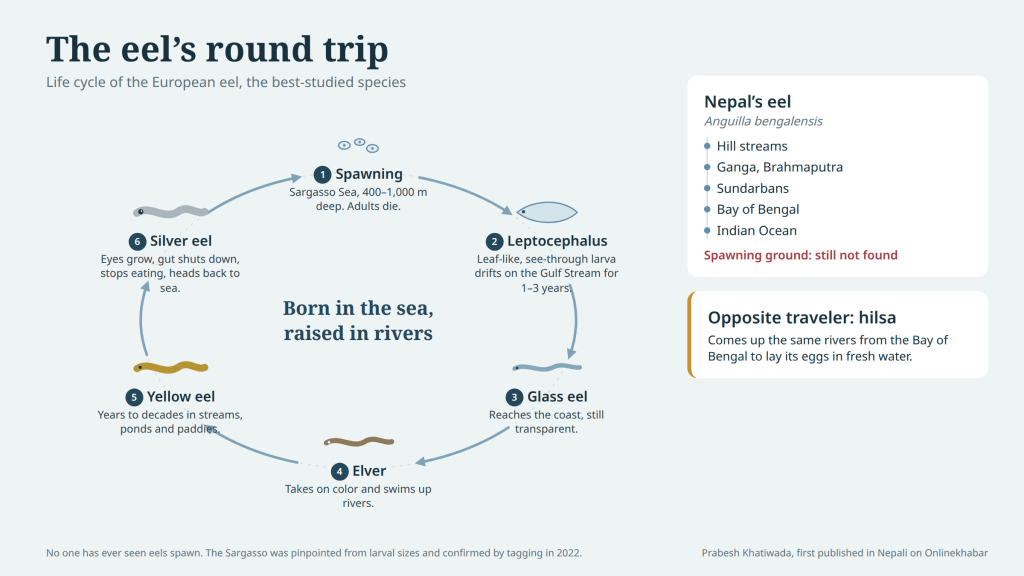
Born in the sea, raised in rivers: the eel’s life cycle at a glance.
Many of us assume the eels (bam) we find in muddy fields during the monsoon rains are native here, like hile, buhari, and other fish. I too learned only much later that the eels found in Nepal are born in the Indian Ocean, spend a few decades in our fields and streams, and return to the very place they were born to have their young.
How freshwater eels reproduce is something we have only recently begun to understand, based on limited evidence and educated guesses. No one yet knows for certain where in the Indian Ocean, across the Bay of Bengal, Nepal’s eels come from. In fact, no one has ever directly observed eels spawning, that is, releasing their eggs and sperm, nor has anyone managed to capture it on camera.
Aristotle’s Mistake and Freud’s Search
Curiosity about how eels are born is nothing new. As far as we know, Aristotle was the first person to investigate it.
Many of us know that a female fish lays eggs, that an embryo forms when a male’s sperm fertilizes them, and that a new fish is born from it. But this is exactly where eels differ from other fish.
Almost all fish have markers that distinguish males from females. In these species, males develop testes and females develop ovaries. But in freshwater eels, the reproductive organs are not fully developed. So, the question arises: if males and females cannot even be told apart, how are eels born?
Some 2,300 years ago, Aristotle asked this very question. No sperm, no eggs, no reproductive organs like those of other fish. Then how do eels suddenly appear every year in fields, streams, ponds, and ditches with no direct connection to the sea?
Eels were found throughout Europe at the time. Aristotle cut open hundreds of them yet could not find any male or female reproductive organs. Having failed despite every effort, he concluded that eels are born spontaneously from mud.
The belief Aristotle established, that eels are born from mud, persisted for a very long time. In 1876, the world-famous psychoanalyst Sigmund Freud had finished school and enrolled to study medicine. During his studies at a research station in Italy, his first research project was an attempt to locate the eel’s testes. Freud wrote in his memoir that after dissecting nearly four hundred eels without finding testes, he turned to the study of the brain.
Today, Aristotle’s claim that eels are born from mud may make us laugh. It may seem absurd now, but for a long time no one had an answer. Because the freshwater eels Aristotle and Freud examined had not yet developed their reproductive organs, Aristotle and Freud could not find them.
Eels are born in the sea. The tiny young set out on a long journey in search of fresh water, changing form along the way, and live out their adult lives once they reach rivers and streams.
While eels live in freshwater away from the sea, their reproductive organs are not fully developed. Only decades later, when it is time to return to the sea where they were born, do these organs begin to develop.
That is why the mystery of how eels are born persisted for two thousand years after Aristotle. The answer was not in the river; it lay hidden in the distant sea. To put it more plainly, even today no one knows exactly how eels reproduce in the sea.
The answer was not in the river; it lay hidden in the distant sea.
Not a Snake, but a True Fish
When I first saw an eel, it looked to me like a cousin of the rat snake: a long, slippery body, no legs, and a smooth, flowing way of moving through water. Neither was venomous, but there was a world of difference between an eel and a snake.
A snake is a reptile. It breathes with lungs, has dry, scaly skin, and even in water it lives on air. Though it may look like a snake in the water, the eel is not a snake but a true fish of the family Anguillidae.
The eel has every hallmark of a fish: jaws, bones, and gills for breathing underwater. A single fin runs in one continuous line from its back, around the tail, to the underside of its body. That fin helps it swim by twisting its body in waves. Like other fish, the eel breathes through its gills underwater. Its skin, however, is rather special.
Although eels have still not been observed spawning, the available evidence points to one conclusion: adult eels swim thousands of kilometers to reach the Sargasso. One night, at depths of roughly 400 to 1,000 meters, they release their eggs and sperm and then die.
Beneath an eel’s skin lie tiny scales, covered by a slippery coat of slime, or mucus. This mucus keeps the skin slick and moist and allows the eel to absorb some oxygen through the skin itself. That is why an eel can survive out of water somewhat longer than other fish.
Slithering like a snake over damp grass or soil, it can travel from one body of water to another. During a drought, it can survive in a dormant state, buried in mud. This is the secret behind eels ‘suddenly’ appearing after the monsoon rains in fields and ponds that had no water before. They did not fall from the sky; they made their own way there across damp ground.
The eel hunts at night, grows slowly, and rarely draws anyone’s attention. It spends most of its life, sometimes as long as 70–80 years, in our streams, lakes, and wetlands. Seeing this, we assume it is a permanent resident of our rivers and streams.
But in truth, eels are only temporary residents in our fields and streams. To bring a new generation into the world, they must return to the same sea.
In truth, eels are only temporary guests in our fields and streams.
The Final Journey and the Body’s Astonishing Changes
After years in fresh water, one day the eel’s body begins to prepare for its final journey.
Its yellowish-brown skin turns a shiny silver, helping it hide in the deep waters of the sea. It is not only the skin that changes; the body begins to change from within. The eyes swell to nearly twice their size because it must now spend the rest of its life in the deep darkness of the sea. The fins grow broader for long-distance swimming, and the snout becomes pointed.
The most astonishing change occurs in the eel’s digestive system. Its stomach stops working, and its gut begins to waste away. Once it sets out for the sea, it never eats again. The fat it stored over years in streams and rivers becomes its only fuel.
Its reproductive organs develop during the journey to the sea. The eel’s entire body is now shaped for a single purpose: to complete that one-way journey from which it will never return.
This is where the eel’s story gets even stranger. One night, it quietly slips down the stream, through the river and past the estuary toward the open sea. But the eel does not simply head ‘toward the sea.’ It sets off in search of one particular place, where millions of eels from around the world arrive: the place it left as a larva, which it never once reached in all its adult life.
The Atlantic Eel’s Birthplace: The Sargasso Sea
According to scientists, eels originated about 50 million years ago in the Pacific Ocean near what is now Indonesia. Since ancient times, eels’ ancestors have been fish that lived in the deep sea.
At first, they were entirely marine fish. Their larvae drifted far and wide on ocean currents. Over time, some eels extended their journeys even further and, because food was plentiful in freshwater, grew accustomed to reaching it and maturing there.
As eels that originated around Indonesia gradually spread into other seas, new species split off. Today, about 16 eel species are recognized. The European eel (Anguilla anguilla), which Aristotle and Freud studied, belongs to the Atlantic group.
The Atlantic eels have a specific place where they are born and to which they return to spawn: the Sargasso Sea.
An eel leaving a European river must swim five to six thousand kilometers, a months-long journey, to reach its destination. It does so without eating, hiding in the depths by day and rising toward the surface at night. Burning the fat, it has stored all its life, it sets out on this one-way journey. After reaching its destination and spawning, it vanishes forever.
Now the biggest question arises: why do eels from Europe and America make such a long, grueling journey back to the same place, again and again?
Interestingly, American and European eels diverged from each other only about 3 to 6 million years ago. In other words, they evolved into separate species long after the Sargasso current system had formed.
The Sargasso Sea, in the Atlantic Ocean near Bermuda, is one of the strangest seas on Earth. Every other sea has some kind of shore, and countries lay claim to parts of it. But the Sargasso Sea has no shore made of land, and no landmass surrounds it. Its boundaries are set by ocean currents.
The winds near the equator blow one way, while those in the middle latitudes blow the other. This pairing of water and wind turns the waters of the Atlantic into a slow whirl that keeps rotating clockwise.
At the center of this ‘gyre,’ a giant whirl of water, the water collects and remains still. That warm, calm, still center is the Sargasso Sea.
Spread over an area nearly six times the size of France, the sea’s surface is covered with a floating golden seaweed called sargassum. The sea takes its name from this seaweed. Because few nutrients rise from the ocean floor to the surface, there are relatively few other creatures or predators here besides the sargassum.
Spawning at Sea, See-Through Larvae and the Journey to the Rivers
These features are why the Sargasso Sea became the birthplace of Atlantic eels. Its water is warm and calm, providing a place where larvae can escape predators, and the surrounding currents carry them toward the coasts.
The eel’s ancestors had settled into this way of spawning at sea long before they ever encountered rivers. More interesting still, this area was the eels’ breeding ground long before Europe and America were as far apart as they are today.
On a dark night, adult eels release millions of eggs and sperm into the deep waters of the Sargasso. The larvae that hatch look nothing like adult eels. They are five to ten millimeters long, transparent as glass and flat as a leaf. Scientists call them leptocephali (leptocephalus).
Because of its strange shape, the leptocephalus was long thought to be just a kind of sea worm. Scientists discovered only toward the end of the nineteenth century that it is the eel’s larval stage.
More interesting still, these larvae are not built to swim long distances on their own. Thanks to their leaf-like, jellyfish-light bodies, they float easily in the water. Their transparency also helps them evade predators’ eyes.
After leaving the Sargasso, the leptocephali drift with the Gulf Stream, the North Atlantic’s great ocean current. For European eel larvae, this drift can last from one to three years. Along the way, they cover thousands of kilometers.
Along the way, they feed on ‘marine snow.’ On this alone, larvae that were five to ten millimeters long in the Sargasso grow to 60 to 90 millimeters by the time they reach Europe.
After months or years of drifting, the larvae arrive in shallow coastal waters. There, they change form again and become ‘glass eels’: transparent as glass yet shaped like eels.
These glass eels gather at river mouths. Then, riding the tides and guided by Earth’s magnetic field, they head upstream into the rivers. Once they enter freshwater, their bodies begin to take on color, and they become ‘elvers.’ These elvers slowly grow into the yellow eels we see in streams and ponds.
Interestingly, American and European eels diverged from each other only about 3 to 6 million years ago. In other words, they evolved into separate species long after the Sargasso current system had formed.
Tens of millions of years ago, the Atlantic Ocean was much narrower than it is today. Europe and America were also much closer together. As the continents drifted apart, the seafloor spread, and eels began entering rivers in search of food. Yet they never abandoned their ancestral breeding grounds.
So it can be said: the river is a habit they picked up later; the Sargasso is their ancestral home, one they never truly left.
The river is a habit they picked up later; the Sargasso is their ancestral home; one they never truly left.
Born in the middle of the sea thousands of kilometers away, the transparent larvae drift on ocean currents for years until they finally reach a stream on a European or American coast. Then they spend decades in freshwater and grow into adults.
How Do They Find Their Way in the Middle of the Ocean?
The adult eel’s life cycle is complete only when it returns to the same place in the sea to spawn. And here is another marvel: how do they find their way across the open sea to the place where they were born? How do they retain the memory of that place after decades in freshwater? How do Atlantic eels swim thousands of kilometers to find the Sargasso Sea, which has no shore or landmark?
The likely answer lies in the Earth’s magnetic field. The magnetic signature of the waters around the Sargasso Sea may be imprinted in the eel’s brain during its youth. As adults, they navigate using that biological memory.
The European eel’s body works like a compass. By reading the Earth’s magnetic field like a map, eels can head toward the Sargasso’s magnetic signature. A 2017 laboratory study that recreated different magnetic conditions also pointed to this possibility.
Even so, the mystery of exactly how they pinpoint that boundless place thousands of kilometers away remains unsolved.
Another question remains: how do eels spawn? No one has ever directly observed them spawning in the Sargasso, nor has anyone captured it on camera. So how did scientists become so certain that this is their birthplace?
How Were Scientists So Sure Without Ever Seeing It?
The first clue to eel reproduction came from their larvae. Toward the end of the nineteenth century, in a laboratory in Italy, researchers watched for the first time as a leaf-like, transparent creature, a leptocephalus, slowly transformed into an eel in a tank.
It became clear that this ‘transparent leaf,’ once thought to be an entirely different animal or a sea worm, was in fact the eel’s larva. Now scientists had a way to trace the eel’s birthplace: wherever the smallest larvae are found, eels must be born.
The Danish scientist Johannes Schmidt followed exactly this lead. From 1904 to nearly 1924, he sailed ships across the Atlantic, cast nets in thousands of locations, and measured the larvae he caught, one by one.
After years of measurement, a clear pattern emerged: the farther from the Sargasso, the larger the larvae; the closer, the smaller. There was only one place where the smallest, newly hatched larvae were found: the middle of the Sargasso Sea.
In 1922, Schmidt published his conclusion that all Atlantic eels are born in the Sargasso. Many other lines of evidence now confirm this: DNA tests, chemical analysis of the larvae’s ear bones, and modern electronic tagging.
In 2022, scientists even managed to track tagged adult European eels to the vicinity of the Sargasso Sea.
Although eels have still not been observed spawning, the available evidence points to one conclusion: adult eels swim thousands of kilometers to reach the Sargasso. One night, at depths of roughly 400 to 1,000 meters, they release their eggs and sperm and then die.
Their bodies are rarely found. However, their young drift back toward the coasts on ocean currents. Once they mature, the same cycle begins again.
The Eel in Our Own Streams and the Mystery of the Indian Ocean
We have told the story of the eels of Europe and America, whose life cycle has been studied more than any other. But the eel’s saga, bound to the sea, is not limited to Europe and America. The eels in our own streams complete the same life cycle in a different sea.
There are about 16 species of eel worldwide, each tied to its own birthplace in the sea.
The eel found in South Asia is Anguilla bengalensis. Its journey is even longer. It descends from hill streams, joins great rivers like the Ganga and the Brahmaputra, crosses the plains, threads its way through the Sundarbans, the world’s largest delta, and passes through the Bay of Bengal into the deep Indian Ocean.
This journey, undertaken by an eel that looks so ordinary in our fields and streams, is one of the longest and least observed animal journeys in the world.
The Japanese eel (Anguilla japonica) makes a similar journey in the Pacific Ocean. Swimming two to three thousand kilometers from the rivers of East Asia, it reaches the West Mariana Ridge, an underwater mountain range, and spawns in the deep darkness around the new moon.
Now the biggest question arises: why do eels from Europe and America make such a long, grueling journey back to the same place, again and again?
This is where our eel becomes most intriguing. We know where European eels go: the Sargasso Sea. But science still does not know exactly which part of the Indian Ocean our eels reach to spawn. The Indian Ocean’s ‘Sargasso’ has yet to be found.
The Indian Ocean’s ‘Sargasso’ has yet to be found.
Atlantic eels spawn in a single area during a particular season. But our tropical eels appear to spawn year-round, possibly in different places.
That ordinary eel that suddenly appears in our fields during the monsoon rains carries within its body a mystery that the world’s great scientists have yet to solve.
Travelers in the Opposite Direction: Salmon and Hilsa
In scientific terminology, creatures that can live in both the salty water of the sea and the fresh water of rivers and streams are called ‘diadromous.’ Those, like the eel, that live in fresh water but migrate to the sea to spawn are called ‘catadromous.’
Fish with the exact opposite life cycle are called ‘anadromous.’ These fish live in the sea but migrate up rivers to spawn.
The best-known example of an anadromous fish is the salmon. It is born in freshwater, spends its adult life in the sea, and at spawning time returns to the very stream where it was born and dies there.
Interestingly, the eel uses the Earth’s magnetic field to find its way, while the salmon finds its way by the smell of the stream where it was born.
But you don’t have to go as far as the salmon to find a fish that travels in exactly the opposite direction of the eel. The famous hilsa, or ilish, of the Bay of Bengal makes just such a journey.
The eel travels down the Ganga and Brahmaputra toward the Bay of Bengal. By contrast, the hilsa moves up from that very bay along the same rivers, sometimes traveling more than 1,200 kilometers upstream to lay its eggs in freshwater.
In the same rivers and the same water, the eel and the hilsa travel in exactly opposite directions: one goes down to the sea to lay its young, the other climbs up the river to lay its own.
Though such a habit of crossing the border between salt and fresh water is rare, there are other examples. The Chinese mitten crab, like the eel, spends most of its life in rivers and migrates to the sea to breed.
Some turtles breed only after returning to the place where they were born. Fish such as the sea lamprey and the sturgeon, like salmon and hilsa, return to rivers to lay their eggs.
Crossing the border between salt and fresh water is not easy. To do so, the body must overhaul its entire salt-balancing system. That is why few creatures take such a risk. Those that do have, over millions of years of evolution, become specially adapted for this seemingly impossible journey.
Next monsoon, eels will return to our muddy fields. They are not ordinary fish wrapped in mud. Their bodies bear the imprint of an ancient sea, and their brains hold a magnetic map of the Earth.
Guided by a biological memory encoded in their DNA tens of millions of years ago, every eel will return thousands of kilometers to the same deep darkness of the ocean.
The eel’s true home was never the river. The truth about this creature that emerges from the mud was something Aristotle could not grasp and Freud could not find. Every eel carries within its body a journey and a mystery for which, even after thousands of years, today’s science still has no complete answer.


Leave a Reply