


Large animals like elephants avert this danger by increasing the number of cancer-resistant genes. Because humans have limited genetic diversity, they could not develop such a strong defense mechanism.
This article was first published in Nepali on Ukaalo on November 2, 2025 (Kartik 16, 2082 BS). This is the author’s own English translation. Read the original: https://www.ukaalo.com/news/30229/
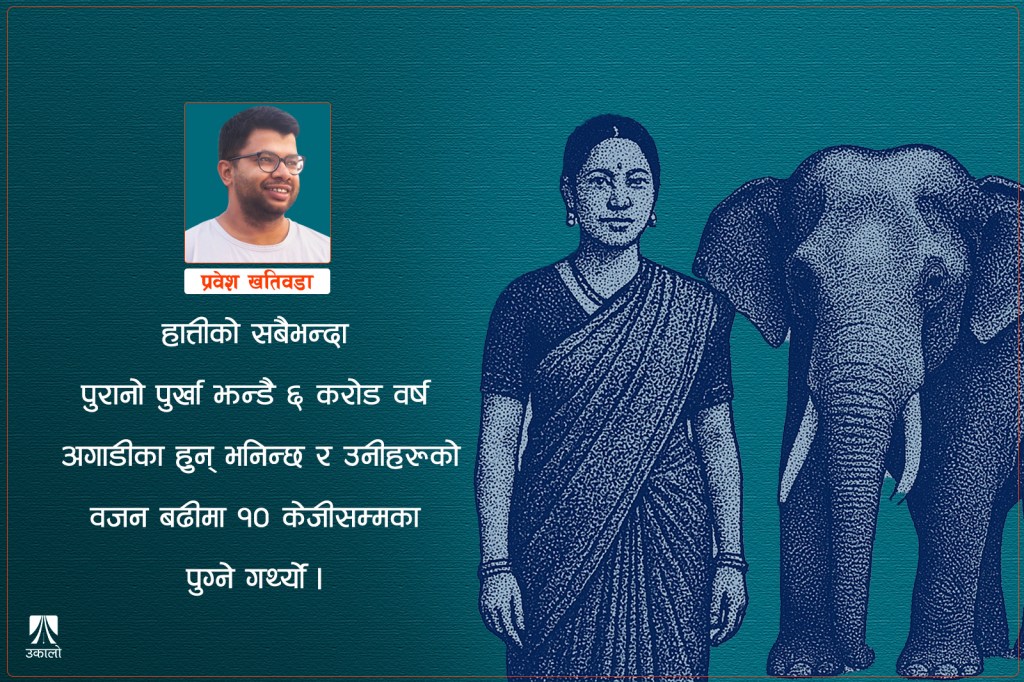
Even though large animals like elephants have billions of cells, cancer is rare in them, while in humans its risk is notably higher. What could be the reason? Let us be clear from the start: the evolutionary reasons behind the different cancer-resistance capacities of elephants and humans, along with differences in genetic diversity, have shaped their ability to resist disease.
Cancer and Body Size: Peto’s Paradox
For a long time, cancer was understood as a problem caused by mutations in cells. As DNA mutations gradually accumulate in each cell, a tumor capable of causing cancer may form. By that logic, the more cells an animal has, the more cancer it should get. But reality is the opposite: the cancer rate is roughly the same across small animals such as mice and large ones such as elephants and whales. In fact, in large animals like elephants and whales, the cancer rate is far lower than in humans.
In the 1970s, the British biologist Richard Peto studied the relationship between age and cancer in mice. Adding body size to the equation, he posed a question: the human body has nearly a thousand times more cells than a mouse’s and a lifespan 30 times longer, so why is there no comparably large difference in cancer likelihood between the two species? In theory, humans should carry a far greater cancer risk than mice—so why isn’t that the case?
One of the most intriguing and fundamental questions in the study of cancer is Peto’s Paradox. This paradox highlights an important idea: cancer is not simply a product of how many cells an organism has, but the result of genetic mechanisms preserved over the course of a species’ evolution.
The Elephant’s Evolutionary Defense Against Cancer: Copies of P53
The elephants found today in Africa and Asia have bodies up to nearly a hundred times larger than ours, with correspondingly more cells. But elephants were not always this big; they evolved from smaller ancestors. The oldest known elephant ancestor is said to have lived nearly 60 million years ago and weighed at most around 10 kilograms. The large size of the elephants we see today emerged about 10 million years ago.
Cancer is not simply a product of how many cells an organism has, but the result of genetic mechanisms preserved over a species’ evolution.
Almost all animals have a protein called P53 in every cell of their bodies. The human body carries only one copy of P53. The main role of the P53 protein in a cell is to detect DNA damage and stop that cell from dividing, or, if necessary, trigger the cell’s self-destruction (apoptosis). When biologists studied the DNA of elephants and their ancestors, they found something interesting: as the elephant’s body grew larger, the number of copies (copy number) of the gene that encodes P53 on its chromosomes also increased.
Alongside its enormous body and long lifespan, the elephant developed this mechanism for making extra copies of the gene as a genetic (evolutionary) adaptation to lower its cancer risk. The oldest elephant ancestor had only a single copy of P53, just like us. As elephants evolved and grew larger, the number of copies of the genes that make P53 also increased, and today’s elephants carry about 20 copies of P53 (13) when P53-like genes (P63, P73) are counted together. In this way, the extra copies of P53 in elephants help prevent cancer by triggering cell self-destruction as soon as a cell’s DNA is damaged.
Making extra copies of P53, however, is not the only strategy for surviving cancer. Over the course of their evolution, elephants, whales, and other species have developed cancer-resistant systems—gene duplication, enhanced tumor-suppressor activity, and strengthened pathways, including DNA-repair mechanisms. That is why, even in today’s polluted environment, cancer is only rarely the leading cause of death in large animals like elephants and whales, or in long-lived animals like tortoises.
So why couldn’t the human species develop the ability to fight cancer?
Limited Genetic Diversity in Humans: The Genetic Bottleneck
Although the human species is physically small, vast in number, and spread across every landmass, our genetic diversity is surprisingly limited. The genetic difference between any two unrelated people anywhere in the world averages only 0.1%. Compare this to the chimpanzee, the closest relative of our species (Homo sapiens). The genetic difference among chimpanzees in eastern and western Africa alone averages 1.2%. In other words, the difference between two chimpanzees from Africa alone is ten times greater than the difference between people from Europe, Asia, the Americas, and Africa. The secret behind this shrinking of diversity in human DNA lies in the evolutionary history of our species.
Humans and chimpanzees are believed to have diverged from a common ancestor nearly 5 million years ago. Based on the evidence found so far, Homo sapiens is estimated to have diverged from other contemporary human species (Neanderthals and Denisovans) roughly 500,000–800,000 years ago. The oldest evidence of Homo sapiens comes from several places (Morocco, South Africa) and dates back nearly 300,000 years. Sister species that left Africa as early as 400,000 years ago and reached Asia and Europe reunited with Homo sapiens only 40,000–50,000 years ago—and evidence of that reunion is still found in many of us living outside Africa.
The difference between two chimpanzees from Africa alone is ten times greater than the difference between people from Europe, Asia, the Americas and Africa.
Humans are thought to have lived in Africa for a long time, venturing out sporadically only about 100,000 years ago. Living in small groups across different parts of Africa, our ancestors gradually developed genetic diversity suited to their local environments. That is why most of the variation within our average 0.1% genetic diversity is still found in Africa today.
What Caused the Bottleneck in Human Evolution? The Toba Eruption
When we study the history of human evolution, we find clear evidence that the population of human ancestors—who evolved for a long time in diverse environments across Africa—dropped sharply at various points. Many scientific studies hold that roughly 70,000–80,000 years ago, the ‘effective population size’ of humans capable of reproducing fell so far that no more than 2,000–10,000 survived.
This severe genetic bottleneck in human history did not merely reduce the number of our ancestors; it permanently changed our genetic makeup.
When we examine the reasons for the extremely low genetic diversity in humans, we find genetic evidence of a bottleneck around 70,000 to 100,000 years ago. Many believe the eruption of the Toba volcano in Sumatra, Indonesia, about 74,000 years ago caused it.
This severe genetic bottleneck in human history did not merely reduce the number of our ancestors; it permanently changed our genetic makeup.
This eruption, the largest known so far, released huge amounts of sulfur gas into the atmosphere and brought a ‘volcanic winter’ to the world for many years. One school of thought holds that the sudden drop in temperature and the food crisis caused by the lack of sunlight reduced the effective population size of humans. However, because other human sister species living in Asia itself did not decline much, Toba cannot be accepted as the definitive cause of the bottleneck.
What Caused the Bottleneck in Human Evolution? The Founder Effect
An important cause of the genetic bottleneck is the founder effect that arose during migration out of Africa. There is also a genetic basis for the view that a very small group of humans left Africa and spread through Asia and Europe to the rest of the world. Similarities are found in mitochondrial DNA (small structures within the cell), which is passed from a woman’s egg/embryo to all of her offspring, and in the Y chromosome found in all men.
There is also a view that everyone outside Africa descends from a single shared mother and father. Biologists sometimes call this common mother and father ‘Mitochondrial Eve’ and ‘Chromosomal Adam,’ respectively. One way to understand this is that only a small founding group from Africa left Africa, and today’s modern humans are descended from them. The reduced genetic diversity seen in non-Africans today is largely the result of this founder effect.
There is a great deal of uniformity in our species, but our deep genetic history makes the story of our evolution even more complex. As this small ancestral group that left Africa about 60,000–70,000 years ago pushed into new regions, smaller subgroups split off at each location. Each migrating subgroup carried only a small fraction of the original population as it spread into new regions, first into Asia and Europe.
As humans spread across the world, the gradual extinction of early subgroups also helped reduce genetic diversity in modern humans. Because of this gradual process, even though our species has spread across the globe, our genetic diversity is far lower than that of other mammal species.
By facing similar bottlenecks during evolution and with a limited founding group leaving Africa, the human species escaped extinction—yet this same history affected our innate ability to fight diseases like cancer.
The Evidence for Bottlenecks in Human Evolution
Although that small founding group, some 45,000–60,000 years ago, saved humankind from extinction, it can be said that it is also the reason our innate ability to fight diseases like cancer was affected.
So when we study the DNA of our species after it left Africa, we find solid evidence of the genetic bottleneck: the very low number of genes, the tendency of genes to stay together, and the time at which genes converge. We did not learn that such a bottleneck once existed from studying ancestral skeletons; biologists discovered it by investigating DNA.
When human DNA is compared with that of many other mammals, the number of genes turns out to be very low—only about thirty thousand in total. This low gene count can be understood as the result of our species evolving gradually from a small number of ancestors, with most rare genes lost forever along with the ancestors who disappeared. Another sign that our species came from a limited set of ancestors is the tendency of genes to stay together (linkage disequilibrium). Genes on a chromosome normally separate gradually as they are passed down each generation. But when the ancestral population is small, this process is much slower. As a result, segments of genes on our chromosomes that should have long since separated are still found linked together today.
Another basis for the genetic bottleneck is the time at which genes converge (coalescence time). When we trace any gene in our DNA backward, all its copies converge on a single common ancestor. When a population is small, this ‘convergence time’ is very short. Analyses of modern human genes show that all our ancestors evolved from a single small group a relatively short time ago, supporting the idea of a breeding population numbering only a few thousand.
Narrowed Genetic Diversity and the Link to Cancer
The most significant consequence of the bottleneck in human evolution is genetic drift. As people split into small subgroups and settled in different places, the likelihood of inbreeding increased. In a large population, natural selection can easily remove harmful mutations (deleterious mutations)—a possibility our evolutionary history took away.
Inbreeding, or the practice of marrying within one’s own community, is still seen among modern humans. Some mutations that raise cancer risk (for example, certain defects in tumor-suppressor genes) remain in an inactive state. Inbreeding increases the chance that previously hidden or inactive (recessive) harmful genes appear together in offspring. Another aspect is that, because of these bottlenecks, the frequency of such harmful genes in the population has kept rising.
Large animals like elephants averted this danger by increasing the number of cancer-resistant genes (such as extra copies of the P53 gene). Likewise, the whale, another giant species, has built additional mechanisms to fight DNA mutation or damage. Because of the limited genetic diversity of the human species, such a strong defense mechanism could not develop.
Narrowed MHC Diversity and the Link to Cancer
The effect of the bottleneck in our species is not limited to new mutations arising through genetic drift. The major histocompatibility complex (MHC) is a group of important genes tied to the immune system’s defense against cancer and other diseases; in humans, it is called the human leukocyte antigen (HLA). These genes play a key role in helping the body’s cells recognize and distinguish ‘self’ from ‘foreign’ (such as cancer cells and viruses).
These MHCs act as ‘molecular ID cards’ that help recognize viruses, bacteria, and tumor cells—the more variants a population carries, the greater its chance of developing an effective immune system. Cancerous cells produce abnormal or mutated proteins; HLA molecules capture fragments of these proteins and display them on the outer surface of the cells that fight cancer (T cells).
Because MHC diversity has been a central pillar of disease resistance throughout evolution, these genes are the most polymorphic—that is, the most diverse—in the entire genome. But this is exactly where the human problem shows up: in most of us, HLA diversity is very limited. Moreover, HLA diversity is much higher in Africa’s indigenous populations, whereas in groups that left Africa, its range has gradually declined.
As a result of the genetic bottleneck, reduced HLA diversity limits the ability to present each cancer-derived fragment. As HLA genetic diversity falls, the likelihood of having HLA molecules that can recognize new or unusual cancer mutations, confront cancer, and present them to T cells gradually declines. This gradual erosion of MHC can be understood as ‘holes’ in immune recognition. Because HLA diversity is low in our species, the risk of cancer developing and spreading can be unusually high compared with other mammals.
Peto’s Paradox, Narrowed Genetic Diversity, and Cancer
All in all, cancer is not merely a rebellion of the body’s cells; it is also the shadow of a paradox left by our species’ evolutionary history. Despite having billions of cells, large animals like elephants and whales evolved mechanisms that lower cancer risk—more copies of the P53 gene, additional DNA-repair systems, and doubled tumor-suppressor activity. Humans lost that evolutionary opportunity because of genetic bottlenecks for various reasons.
The paradox Peto observed between mice and humans is also interesting. In mice, cells divide rapidly, life is short, and the mutation rate is high—so tumors appear quickly. Because humans live a long time, tumors develop slowly, and the immune system has to confront them over a long period. When the diversity of MHC and DNA-repair mechanisms is limited, that very long lifespan becomes a new weakness: the body cannot control the cumulative consequences of mutation.
Cancer is not merely a rebellion of the body’s cells; it is also the shadow of a paradox left behind by our species’ evolutionary history.
So Peto’s Paradox is not just a paradox between species; it is also a paradox within us. We have intellectually advanced brains and the ability to develop medicines, but in evolutionary terms we are still descendants of a small, genetically limited group—and because of that, we lost the chance to develop the biological shields that guard against diseases like cancer.


Leave a Reply