


All medicines and their side effects cannot be lumped together and discussed in one breath. And for a physician who has worked in this very field for a long time to make an absurd pronouncement is even more shameful.
This article was first published in Nepali on Ukaalo on November 13, 2025 (Kartik 27, 2082 BS). This is the author’s own English translation. Read the original: https://www.ukaalo.com/news/30475/
After a kidney or any other organ transplant, a person must take immunosuppressants (drugs that suppress the immune system) for life. Immunosuppressants can also cause side effects, and extensive research has been done on them. As someone who understands how the immune system and immunosuppressants work, I have written about them here to clear up a public misconception about a side effect of immunosuppressants that occurs in fewer than 5 percent of people.
Why Does the Body Need Its Kidneys?
When it comes to removing almost every kind of waste that enters the body, the kidney is the most important organ. We all have two kidneys; in women, each kidney weighs about 135 grams, while in men, they are slightly larger, about 150 grams.
The kidney’s job is not just to remove the body’s waste. It also plays an important role in regulating blood pressure, electrolyte balance, and hormonal balance, and in bone development. It is ideal if both kidneys perform the same work; otherwise, a single kidney can do the job too.
The kidney’s capacity to clear waste is also limited; if it has to filter more than it can handle in a day, it comes under extra strain. Many people mistakenly believe that drinking lots of water is good for the body and the kidneys. It is true that drinking too little water is bad for both the kidneys and the body. Drink water as needed, but drinking a lot of it does not make the kidneys any better.
Physical imbalances in our bodies, for various reasons, gradually erode the kidneys’ ability to filter waste. In all of us, kidney function declines not only because of kidney disease but also because of age, diet, and nutritional imbalance. In the context of this article, the state in which both kidneys can no longer work is understood as ‘kidney failure.’
Once the kidneys that filter the body’s waste stop working, one cannot survive for long. In some cases, dialysis can extend kidney function for days or months and prolong life, but that too is not a permanent solution.
Transplant, Transplant Rejection and Immune Suppressants
The permanent solution for kidney failure is a new kidney- that is, a ‘kidney transplant.’ When both of someone’s kidneys stop working, ‘borrowing’ a kidney from someone else and putting it in is a kidney transplant. If the first transplanted kidney does not work, those who can afford it sometimes get yet another new kidney. We have all heard about the ordeal of where and how a kidney is ‘borrowed’; let’s not go there today.
A new kidney has to be transplanted- but where would it come from? None of us has more than two kidneys! Yet our bodies can function well with just one healthy kidney. Someone with two healthy kidneys donates one to a patient whose kidneys have failed. But as soon as a new kidney is transplanted, the body does not recognize it right away.
All of us have an inborn defense system (immune system) in our bodies. It is this immune system that recognizes a new kidney as a foreign substance (foreign object) and tries to reject it. Why the immune system attacks a new kidney as a foreign substance- or why a kidney donated by as close a relative as possible is said to be best- I will reveal in the last section of this article.
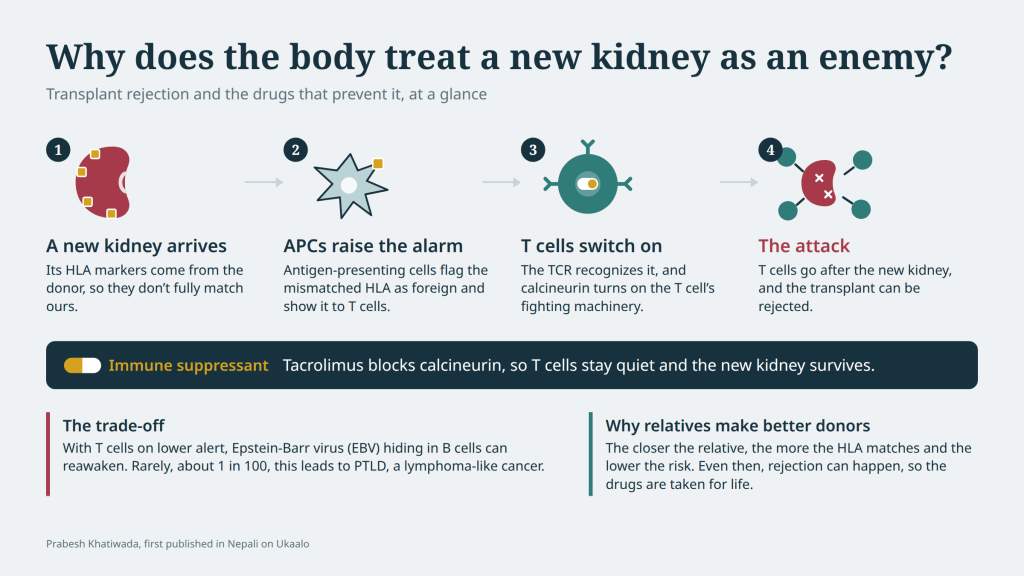
Because of this attack by the immune system, a kidney transplant can fail. Since the new kidney comes from another person, there is always a chance the immune system will reject it. That is why patients who have had an organ transplant must take medicine to prevent this (immune suppressants) for life. These drugs are used mainly to reduce the activity of T cells—the core soldiers of the immune system- and have a wide variety of effects. Because each drug has different effects, there are naturally many co-effects and side effects too.
Our country’s former Prime Minister, KP Sharma Oli, underwent a second kidney transplant some years ago, possibly in India. I had heard somewhere an ‘indigestible comment’ made by a senior doctor who has long worked on kidneys, about a side effect of the immunosuppressants Oli had to take after his transplant.
Surely that doctor sahib must have studied the difference between a drug’s effect and its side effect! It is well known that many people spread medical and health rumors on social media due to a lack of knowledge, but what I could not accept was the jab from a doctor like him, linking a side effect of immune suppression to someone’s mental health.
He surely knows more than I do about kidney failure. But I also know at least a little about organ transplants, transplant rejection, and immunosuppressants. As a researcher in this field, I have made an effort to write what I know.
A Side Effect of Immune Suppressants: Reactivation of EBV and Other Viruses
There is a virus called the Epstein-Barr virus (EBV) that is associated with cancer. This is what I work on. This virus infects everyone in childhood.
The immune system detects an EBV infection in early childhood quickly and easily. It recognizes EBV as a foreign antigen and launches an attack to destroy the virus. In this way, our immune system clears EBV and reduces the viral load in one go. This process is called immune clearance. Because our immune system clears EBV so easily in childhood, an early EBV infection usually goes unnoticed.
Immune clearance, however, is rarely one hundred percent. Some EBV can hide dormant inside the blood’s B cells (immune escape). They remain inactive, shutting down their programs for making viral proteins. We all carry EBV- some in small amounts, some in somewhat larger amounts.
In everyone, childhood EBV infection also leaves an imprint on the immune system. After EBV first infects us, immune cells that recognize it are formed, and their constant vigilance keeps the hidden virus from reactivating.
All of us always carry EBV- some in small amounts, some in somewhat larger amounts.
Everyone who has had an organ transplant takes drugs that weaken the immune system- immune suppressants. But when do you ever get a laddu in both hands? On the one hand, without immune suppressants, organ rejection puts the patient’s very life at risk. On the other hand, taking immune suppressants to avoid that raises the chance that EBV and many other viruses lying dormant in the transplant recipient’s DNA will become active again.
EBV is a cancer-causing virus. Reactivated EBV can cause cancer in the B cells of the blood. When EBV reactivates, it drives uncontrolled B-cell growth, which is called EBV lymphoma. It is like the tumor of other cancers; if it keeps growing, it can take the form of cancer. Although such cancer doesn’t occur under normal conditions, transplant patients on immunosuppressants face a higher chance of this cancer- PTLD (post-transplant lymphoproliferative disease). The chance of PTLD with immunosuppressants after a kidney transplant is now considered to be less than about one percent.
One side effect of immunosuppressants is EBV reactivation and PTLD. At first glance, then, using immunosuppressants carries a risk that EBV becomes active and causes PTLD. And PTLD is a type of cancer.
Is it fair to flatly declare that immunosuppressants cause cancer? It is not that PTLD never occurs with immunosuppressants, but it doesn’t occur in everyone. Before declaring that they cause cancer, it is important to understand that the likelihood is less than 1 percent- and, knowing this, not to mislead anyone.
Tacrolimus, an Immunosuppressive Drug: The Difference Between Its Effects and Side Effects
Every medicine is made for a specific purpose, and its aim is usually a good one. Beyond a drug’s intended effect, almost every drug carries the possibility of co-effects and side effects. Some drugs have few side effects, while others have many. Side effects can also differ depending on the type and brand of the drug. A drug designed to weaken the very immune system that protects our body is bound to have certain side effects.
Before declaring that they cause cancer, it is important to understand that the likelihood is less than 1 percent- and, knowing this, not to mislead anyone.
In transplants, tacrolimus is most commonly used as the immunosuppressant. It works by inhibiting calcineurin, a protein important for T cells, the immune system’s soldiers. Its use also causes other side effects. Besides PTLD, with its less-than-1-percent chance discussed earlier, the likelihood of other side effects is about the same.
Tacrolimus is not a new drug; the FDA, the agency that approves drugs in the United States, cleared it for use in 1994. Many studies have examined the side effects that can come with its use, and these must continue to be reported. Doctors who prescribe tacrolimus are aware of these side effects. That is why everyone who has had a transplant also takes additional medicines alongside the immunosuppressant to prevent side effects.
It should also be understood that a medicine taken for life does not have to be taken at the same dose forever. In the first few years after a transplant, the risk of organ rejection is somewhat higher. As the body gradually gets used to the new organ, that risk keeps falling. At that stage, doctors also gradually reduce the tacrolimus dose.
I don’t know exactly which medications former Prime Minister KP Sharma Oli takes after his kidney transplant. I can only guess that he likely uses tacrolimus in combination with drugs to protect against its known side effects.
As the doctor mentioned above said, tacrolimus does have side effects. But the likelihood is small- less than 5 percent. In other words, out of a hundred people taking tacrolimus, five might develop the kind of illness he spoke of.
In such a situation, my ethics would certainly not allow me to call a tacrolimus user a patient with PTLD cancer, whose likelihood is less than 15. To me, it is not justified for the doctor sahib either to pick out a side effect with less than a 5 percent chance and pronounce on someone’s mental balance. The doctor himself should know a drug’s effects and side effects, its dosage, and that one must not tell someone ‘You have this illness’ without even making a diagnosis.
Let us understand a little more about why tacrolimus or similar drugs must be used when transplanting a kidney or another organ.
How Does Our Immune System Work?
As I said at the beginning of the article, our innate defense system recognizes and distinguishes the body’s ‘own’ (self) substances from ‘foreign’ ones. Our immune system, including the white blood cells (WBCs) in our blood, is highly agile, but for it to work, many types of immune cells must come together in the right balance.
The immune system includes many kinds of immune cells, including T cells among the WBCs, all working together. They keep constant watch and carry information to the T cells that fight threats. For the body’s defense system to work, the many roles of each immune cell, their effects, and the interplay between those effects must come together.
Our first shield (defense system) is our innate immune system (innate immunity). From the day we are born, it protects us from all kinds of foreign substances (viruses, bacteria, allergens, and so on). Macrophages and neutrophils, which we count in a blood test or blood report, and complement proteins, also found in tears and sweat, are part of innate immunity. Although innate immunity is always active and can fight many threats, it doesn’t recognize specific invaders and is not very effective.
The adaptive immune system (adaptive immunity) is our second layer of protection, and it is far more powerful than innate immunity. Adaptive immunity begins its work only after its first contact with a foreign substance. Once it has come into contact with a foreign substance, however, adaptive immunity recognizes it specifically and stores its memory forever.
How Does Our Immune System Work?
To recognize foreign substances (antigens), a class of cells- monocytes, macrophages, dendritic cells, and others- should be understood as antigen-presenting cells (APCs). Constantly circulating on patrol, these cells recognize foreign antigens and carry them to the cells that can confront the external threat. The major histocompatibility complex (MHC) on APCs plays an important role in recognizing foreign antigens.
In humans, MHC is called the human leukocyte antigen (HLA). They are perhaps the most important players in adaptive immunity. They remember every vaccine we have received and every disease we have had. Not only that- the memory of diseases that struck our ancestors long ago and the ability to survive them are also embedded in them.
Because we evolved from small, limited early ancestors, we don’t have much HLA diversity. Even so, HLA genes are the most polymorphic of all- many times more so than any other genes. Their polymorphism comes from the many combinations of countless alleles of HLA’s three main genes. To a large extent, the greater the HLA diversity, the stronger our immunity tends to be.
Greater HLA diversity generally leads to stronger immunity.
HLA also comes in two types, HLA-I and HLA-II. HLA-I presents antigens only to CD8 T cells, while HLA-II presents them only to CD4 T cells. On the surface of both types of T cells is another important molecule, the TCR, which must recognize both the HLA and the foreign antigen it presents. Because HLA must recognize the foreign antigen before the TCR does, HLA diversity is also the main driver of TCR diversity.
How Does Our Immune System Work?
The first soldiers of adaptive immunity to fight external attacks are B cells. By making antibodies, they target pathogens, including bacteria and viruses. They also have a kind of memory, through antibodies, for fighting a threat they have recognized before. The antibodies that B cells make from new and old encounters with external pathogens help activate CD4 and CD8 cells. But when B cells become active and make antibodies, the bigger effect is activating natural killer cells.
The most effective roles in adaptive immunity are played by the two types of CD3-bearing cells- CD8 and CD4 T cells. Of the two, CD8 T cells are somewhat more active, and CD4 T cells are generally thought to play only a supporting role for CD8 T cells in most situations.
CD4 T cells come in many types and perform many functions. In the context of cancer, depending on their location in the body and the type of cancer, some may play a helpful role while others may be unhelpful. These days, it is increasingly accepted that CD4 cells are not just helpers but can also attack cancer cells directly. There is a type of CD4 cell that can continue working to a large extent even under heavy immune suppression. These are called cytotoxic CD4 cells.
My research aims to determine whether these cells can be used to treat cancers such as PTLD. The reason my research uses CD4 rather than the more effective CD8 is that immunosuppressants and immunocompromising factors like HIV affect CD4 cells more severely. Another reason is that CD8 cells depleted by immunosuppression can regenerate quickly, whereas the process of making new CD4 cells is very slow.
How Does Our Immune System Work?
T-cell TCR diversity is as important as HLA polymorphism. What’s more, the TCR is bound to recognize both the HLA on the APC that encountered and recognized the antigen and the antigen that HLA carries.
The diversity of HLAs on APCs enables recognition of foreign antigens. The HLA on APCs is of two types- HLA-I and HLA-II- which recognize TCRs on CD8 and CD4 cells, respectively. Because MHC-I is far more abundant than MHC-II, CD8 cells play a larger role in disease resistance.
Thus, if the TCR cannot properly recognize both the HLA and the antigen it carries, the TCR (and even the antibody-making B cells) cannot function properly. As soon as the TCR detects a foreign antigen, the internal defensive machinery in every kind of T cell starts working.
The Work of Calcineurin and Immune Suppression
Regardless of T cell type, another key protein in the pathway switches on its internal machinery: calcineurin. It holds the key to the T cell’s ability, or machinery, to confront foreign substances and defend the body. If calcineurin is blocked, the T cell’s capacity can be eroded.
The immunosuppressants used in kidney or other organ transplants target this very calcineurin. Tacrolimus and cyclosporine act directly against calcineurin to weaken it. Drugs that block other cytokines produced when calcineurin is activated- including IL-2 and IL-6- have also recently started being used in medicine.
As already said above, if any of us needs an organ transplant, the body does not recognize the replaced organ right away at first. Immunosuppressants, including tacrolimus, are used so the body does not attack the new organ, and the transplant does not fail.
The question may come up again: aren’t T cells supposed to fight viruses and bacteria? Why would T cells attack a new kidney that had to be transplanted because both of the body’s own kidneys stopped working? A new kidney or other organ isn’t a disease-causing foreign substance like bacteria, viruses, or allergens- so why does the immune system turn on it?
Why Immune Suppression When Transplanting a Kidney or Other Organ?
There are two reasons our body’s T cells don’t attack any of our own organs. First, because the MHC combination on our APCs matches that of our organs, they don’t recognize our own organs as foreign substances. Second, regulatory T cells provide a second layer of protection. They have specific TCR sequences that recognize our body and are recognized only by them; if other T cells try to attack too much, they detect it at once and in turn attack those T cells and weaken them.
That is why it is said that, for any organ transplant, it is best to receive the organ from close relatives, when possible. The secret lies in HLA polymorphism in our DNA. This is because close relatives share more of their HLA sequences, and self-antigens may already have formed. Because of this closer HLA match, the closer the donor and recipient are, the lower the chance of transplant failure.
If the donor and recipient are twins, their HLA types match. In the rest of us, an HLA mismatch exists somewhere. The antigen-presenting cells (APCs in our bodies recognize this mismatch as a foreign antigen and prepare our T cells to fight it. Because T cells mistake the newly transplanted organ for a foreign antigen or a disease, they attack it, which can lead to organ rejection and transplant failure.
The secret lies hidden in the polymorphism of HLA in our DNA.
It has been said that the closer the donor and recipient, the smaller this danger. But we must not forget that the danger exists for everyone. Even when the donor and recipient are twins with a complete HLA match, the risk that the transplanted organ will be rejected for various reasons remains, though it is somewhat smaller. It is to prevent this very transplant failure, which can happen to anyone who has had a transplant, that immunosuppressant drugs, including tacrolimus, have to be taken for life.
All medicines and their side effects cannot be lumped together and discussed in one breath. For a physician who has worked in this field for a long time to make an absurd pronouncement is even more shameful. My knowledge is limited; I don’t know much about the inner workings of drugs. I knew about the immune system, immunosuppressants, and PTLD, so I wrote. The doctor sahib I discussed above, but did not name, has done a great deal of work on this subject. He certainly ought to know about side effects and the sensitivity of the words he used. It would be better if experienced people in medicine didn’t start talking loosely the moment they see a crowd and a camera.


Leave a Reply